
thought leadership
Health plans’ quarterly performance: A path to recovery but continued margin pressures
By Shukai Zhang, Michael Lutz, Eric Levine | September 2, 2026



Publicly traded health plans recently reported their second quarter financial performance. To assess reported trends, Avalere Health analyzed 10Q forms and filings and earnings call transcripts from six publicly traded health plans: Centene, Cigna, CVS Health, Elevance Health, Humana, and UnitedHealth. Overall, we found that while margins have increased year-over-year, elevated medical costs continue to pressure plans, forcing plans to reexamine membership profitability and reevaluate growth strategies. The table below summarizes Q2 year-over-year trends in key metrics across all the plans we analyzed.
Table 1. Health plans trends and outlook in Q2 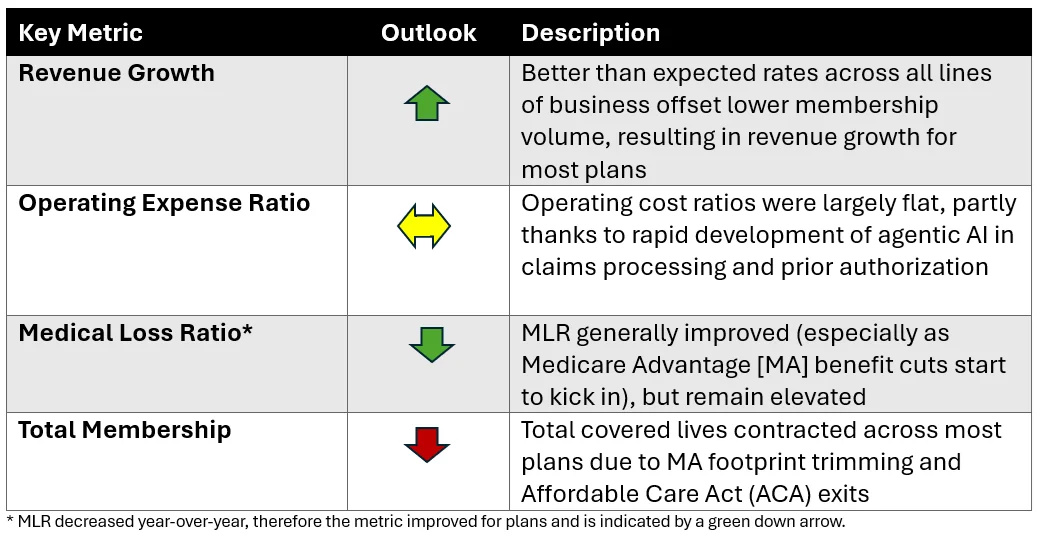
We identified trends across three lines of business:
- In MA margins are the biggest growth factor, not membership. After years of aggressive MA expansion, the industry is now focused on strategic market decisions where per-member- profitability is prioritized over membership growth. Many plans executed plan redesigns and exited underperforming regional counties to improve MLR and profitability per lives covered. Notably, Humana remains the industry outlier, as it is the only publicly traded health plan to continue its focus on membership and market share growth in MA.
- ACA marketplace and other commercial plans are strategically navigating cost increases. Most commercial and ACA Marketplace plans saw medical costs significantly increase in the second quarter. Some plans also cited the No Surprises Act’s Independent Dispute Resolution process as contributing significantly to the overall cost, resulting in out-of-network payouts that exceeded benchmarks. UnitedHealth Group is the most vocal about this process and described it as ineffective on their earnings call. As a result, three plans are executing planned exits from some ACA markets to further protect their margins. While some commercial plans benefit from favorable risk adjustment, relying on subsidized plans remains a risk.
- State Medicaid policy uncertainties obscure outlooks. The Medicaid market remains heavily dependent on state payment rates, and plans are experiencing unique issues across redeterminations, member acuity, and eligibility and work requirement updates. Most plans noted that Medicaid members as skewing toward high acuity, further contributing to the margin pressure. However, plans continue to monitor state policies and are not rushing to alter their Medicaid strategies.
While the worst margin crunch has likely passed, in the next few quarters health plans will continue to face pressure on profitability and may have to continue to make drastic market shifts to stabilize MLRs. Plans need to accurately balance membership and profitability, rather than simply relying on volume and footprint growth. Maintaining operating expense ratio is more important than ever, and plans are likely to continue to invest in AI infrastructures to maximize coding and utilization management efficiencies.
Avalere Health helps plans navigate strategic market decisions, improve business processes, and navigate policy dynamics. Our experts bring a range of experience and expertise support plan leaders across all lines of business and multiple functional areas. We offer a range strategic to operational support, including market entry assessment, retention and growth strategy, business process improvement, and operational compliance. Contact us here to learn more.