
thought leadership
How do Medicare Advantage and Medicare FFS utilization patterns differ?
By Brooke Fruman, Annie Song, Arka Ghosh, Kate Davidson | October 30, 2026
Meaningful utilization differences exist between Medicare Part B FFS and Medicare Advantage, with some outliers.
Written by:

Associate Principal



Background
At the product level, utilization often varies by payer type (e.g., commercial plans vs. Medicare plans). Within Medicare, physician-administered drugs are covered under two distinct benefit types: Medicare fee-for-service (FFS) and Medicare Advantage (MA).
Understanding where utilization is most concentrated and how beneficiaries most commonly access certain drugs provides a foundation for shaping targeted access strategies and ensuring beneficiaries do not face coverage-specific access barriers. Avalere Health sought to understand the degree to which structural differences between Medicare FFS and MA translate into utilization differences between the programs.
Avalere Health conducted an analysis of 2023 Medicare Part B claims and MA encounter data to identify the proportion of 30-day equivalent supplies (30DES) in FFS vs. MA in 2023. The product-level analysis included drugs used for gastroenterology, immunology, and rheumatology indications.
Findings
- The majority of drugs had greater utilization in Part B FFS than MA, with only one drug having greater utilization in MA.
- Two products had approximately 300 30DES in Part B FFS, compared with less than 100 30DES in MA, suggesting that most beneficiaries using these products may access them through FFS Medicare
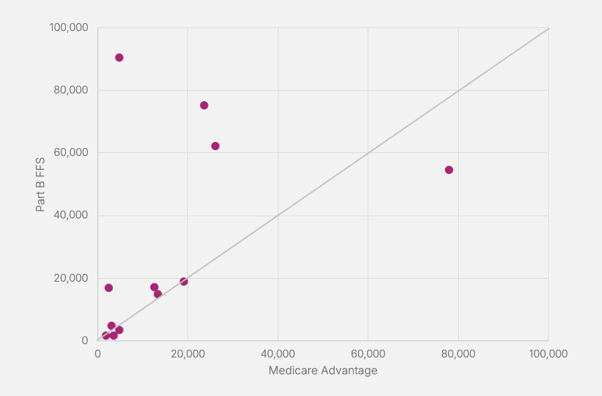
- Several products, particularly those with lower overall utilization, had more equivalent 30DES volume in both FFS and MA.
Figure 1. Overview of 30DES in Part B FFS vs. MA, 2023
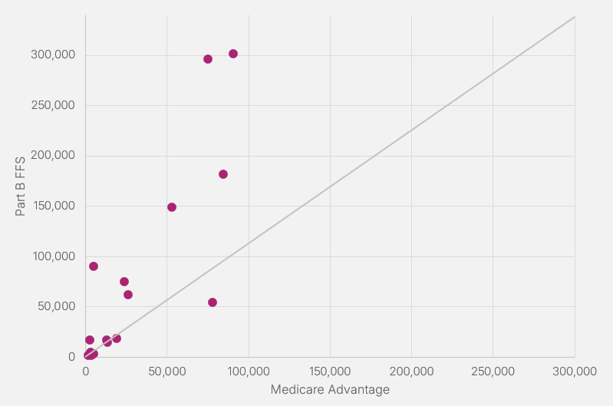
Figure 2. In-depth view of 30DES in Part B FFS vs. MA, 2023
Implications
These findings confirm that meaningful utilization differences exist between Medicare FFS and MA. These differences may be due to distinct patient mixes and patient access across the programs. The results suggest that market access strategies should reflect each product’s utilization mix across FFS Medicare and MA. For products concentrated in FFS, manufacturers may prioritize provider reimbursement and patient affordability support strategies, while MA-specific engagement should also address plan-specific prior authorization and step therapy requirements for Part B drugs. These trends may be exacerbated for products that may be used in earlier lines of therapy and/or with a broader patient population.
Effective access strategies must account for the steep competition in these products’ respective therapeutic areas (rheumatology, gastroenterology, and immunology. Evaluating these patterns as part of an access strategy can help identify where to prioritize payer engagement, assess coverage policies, and strengthen provider support. Additionally, beginning in 2028, negotiated prices for selected Part B drugs will also change reimbursement benchmarks and could influence provider economics and MA plan dynamics. These dynamics may be especially pronounced for products used in both medical and pharmacy benefits and may lead to broader changes in coverage and access by benefit.
Interested in learning more? Connect with us to understand how Avalere Health supports clients in developing effective access strategies across payers.
Methodology
Avalere Health used 2023 Medicare data through an agreement with the Centers for Medicare and Medicaid Services (CMS), wherein Avalere Health has access to data from CMS’ Chronic Conditions Warehouse Virtual Research Data Center, including:
- 100% Medicare FFS Part B claims
- 100% Part D prescription drug event data
- 100% Medicare Advantage encounter data
Disclaimer
The analysis relies on Medicare data sourced from CMS’s Virtual Research Data Center (VRDC Data). Avalere Health relies upon the accuracy, and completeness of the VRDC Data without inquiry and makes no assurances or warranties in relation to the accuracy or completeness of the VRDC Data. CMS retains ownership of the use of VRDC Data, and the use of such data is subject to the terms of Avalere Health’s agreement with CMS and CMS rules.
Michael Ciarametaro also contributed to this article.