
thought leadership
Medicare’s proposed IPCI and modifier 25 changes could reduce dermatology reimbursement
By Maddi Davidson, Vivian Ting | October 7, 2026
CMS’s proposed changes to practice expense calculations and same-day service payment reduction will reduce Medicare payment for dermatology services. Relative to 2026 payments, Avalere Health estimates a payment decrease of nearly 16% when both policies are applied nationally to services among Medicare fee-for-service beneficiaries treated in dermatology offices.


How Medicare pays for physician services
Medicare pays clinicians under the Medicare Physician Fee Schedule (MPFS), which CMS updates annually. Payment for each service is determined by the relative value unit (RVU) assigned to that service, multiplied by the conversion factor (set annually), and adjusted for geography, quality, and sequestration.
The service’s total RVUs comprise three components:
- Work RVU: Accounts for the clinician’s time, effort, skill, and intensity required to furnish a service
- Practice expense (PE) RVU: Captures the cost of operating a practice, including both direct costs (e.g., clinical labor, supplies, equipment) and indirect costs (e.g., administrative overhead)
- Professional liability (“malpractice”) RVU: Reflects malpractice insurance costs
The overall impact of an RVU on a practice or specialty’s payment rate depends on the size of the change and the volume and mix of services furnished. Other payment policies may compound these effects.
Selected payment changes in the CY 2027 MPFS proposed rule
In the CY 2027 Medicare Physician Fee Schedule (MPFS) proposed rule, CMS proposes changes that would redistribute physician payments. If finalized, the policies would take effect January 1, 2027. The sections below highlight selected policies and do not represent a comprehensive review of the proposed rule.
Two-year phaseout of the indirect practice cost index (IPCI): CMS proposes to phase out the IPCI, a specialty-level adjustment used to allocate indirect practice expenses. The IPCI relies largely on specialty cost-per-hour data from the American Medical Association’s 2007 Physician Practice Information Survey. CMS maintains that these data can outweigh newer service-level inputs, producing less transparent and potentially counterintuitive payment results.
CMS would apply 50% of the IPCI adjustment in CY 2027 and eliminate the IPCI in CY 2028. The agency notes that the IPCI has historically limited year-over-year variation in PE RVUs. To offset this risk, CMS also proposes a stabilization adjustment to mitigate payment volatility.
Practice expense stabilization adjustment: To reduce payment volatility, CMS proposes a 5% stabilization adjustment that would apply during a specific step of the PE RVU payment calculation that would limit annual increases or decreases in a service’s PE RVUs. However, this 5% stabilization cap is applied before the statutory phase-in and budget neutrality adjustments, which means a code’s final PE RVU may change by more than 5%. The adjustment would not apply to new or revised codes, revalued codes, or newly nationally priced services previously paid through contractor pricing. Changes to work or malpractice RVUs, the conversion factor, and other payment policies could result in a larger change to a service’s total payment. The changes to PE RVU will continue beyond 2028 when the IPCI is fully removed because any services that were subject to the 5% stabilization step will be incrementally adjusted year over year until IPCI changes are fully recognized.
CMS also proposes separate claim-level payment policies that could have specialty-specific effects.
Payment reduction for certain same-day services “modifier 25”: CMS proposes to reduce payment when a separately identifiable office or outpatient evaluation and management (E/M) visit is furnished by the same physician or practice on the same day as a procedure with a 0-, 10-, or 90-day global period. Under the proposal, CMS would pay the highest-valued service at 100% and reduce payment for each additional E/M visit or applicable procedure by 50%. CMS maintains that providing these services together creates efficiencies and may result in duplicative payment under the current methodology.
CMS estimates that the proposal would have the largest negative impact on dermatology, otolaryngology, and podiatry, as these specialties more frequently bill E/M visits with modifier 25 on the same day as procedures with global periods.
Estimated impact on dermatology payments
Avalere Health analyzed 100% Medicare fee-for-service Part B carrier claims to estimate the national impact of the proposed IPCI phaseout and Modifier 25 payment reduction on dermatology practices. The analysis holds service volume constant and compares baseline payment to future scenarios. The baseline and future scenarios incorporate Medicare’s existing multiple procedure payment reduction (MPPR).
Primary scenarios modeled included:
- Baseline: CY 2026 RVUs with CY 2026 non-APM conversion factor
- All PE changes: Fully implemented and non-stabilized (“fully implemented”) PE RVU with CY 2027 non-APM conversation factor
- Modifier 25 only: CY 2026 RVUs with CY 2026 non-APM conversion factor with modifier 25 payment reduction
- Combined: Fully implemented PE RVU and modifier 25 payment reduction with CY 2027 non-APM conversion factor
Secondary scenarios modeled included:
- 2027 combined scenario: CY 2027 RVUs with CY 2027 non-APM conversion factor with modifier 25 payment reduction
- 2028 scenario: Projected CY 2028 RVUs based on estimated 100% IPCI phase out with CY 2027
non-APM conversion factor with modifier 25 payment reduction
The secondary scenarios differ from the primary scenarios because these reflect the proposed stabilization policy that will limit the impact of the IPCI phase out in 2027 and 2028, while the primary scenarios reflect a future state where incremental stabilization has ended. The period to reach this point will vary by code, therefore, the primary scenarios reflect a future state when all services’ PE values have reached this point.
Baseline
Nationally, dermatology practices furnished approximately 20 million claims in 2025, representing about $4.5 billion in baseline Medicare payments using the CY 2026 non-APM conversion factor. Of these, about 60% of E/M claims and 73% of claims for procedures with 0-, 10-, or 90-day global periods were billed on the same date by the same provider or practice and would fall within the scope of the proposed modifier 25 policy.
Future scenario impacts
Avalere Health estimated the following national-level payment impacts if proposals are finalized, relative to baseline (Table 1).
- All PE changes: Payments are estimated to decrease by 10.0% based on the fully implemented IPCI proposal
- Modifier 25 only: Payments are estimated to decrease 7.1% if 2026 RVUs and conversion factor were held constant and the only payment change was to reduce payment for certain same day services
- Combined policies: Payments are estimated to decrease by 15.9% when combining the IPCI phaseout and modifier 25 policies
Table 1. Estimated dermatology payment change based on 2027 MPFS proposed rule
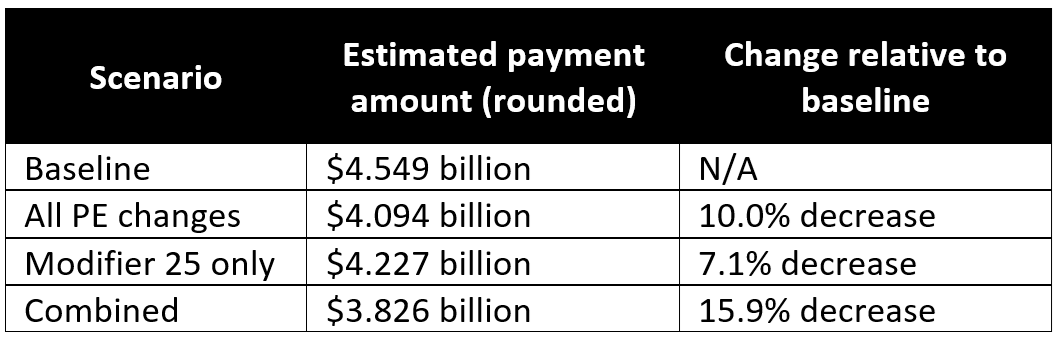
The combined impact reflects changes in both service-level payment and PE RVUs. Results exclude geographic adjustments and sequestration. The policy impact is less than the sum of the individual policies because the reductions compound on the same subset of claims.
In addition to the primary scenarios, Avalere Health also modeled incremental changes in payment to reflect CMS’s proposal to phase out IPCI over two years and implement a stabilization factor to limit the impact year over year (Table 2).
Table 2. Estimated national payment effects, secondary scenarios, combined policies
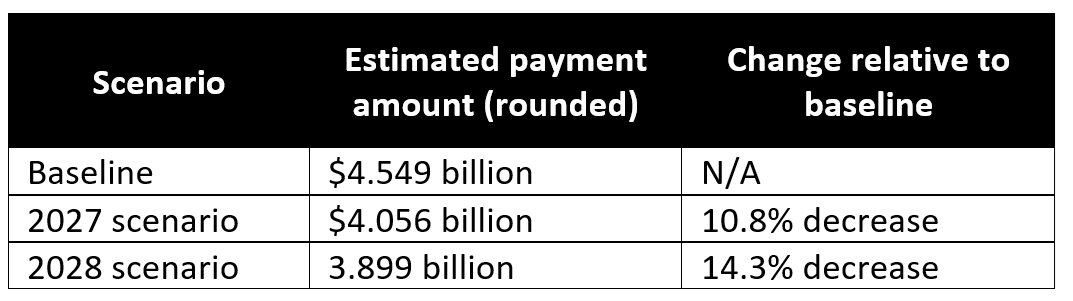
By using the 2026 conversion factor to calculate baseline payment, the payment changes reported above represent the payment reduction based on each policy as well as the conversion factor decrease proposed for CY 2027. The proposed CY 2027 conversion factor for non-APM practices is $32.84, a 1.68% decrease from $33.40 in CY 2026.
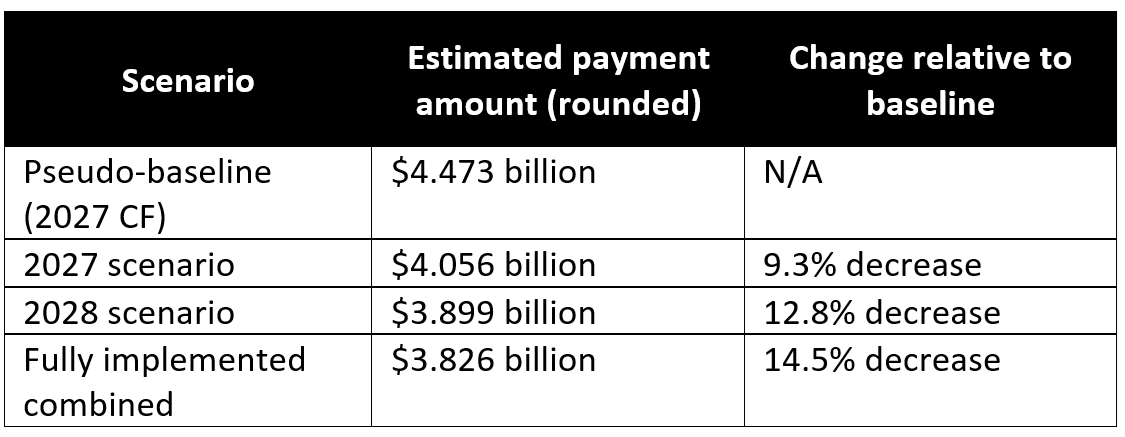
To represent the policy proposal impacts on payment change, absent a change to the conversion factor, Avalere Health also estimated a version of the baseline using the CY 2027 conversion factor. This does not represent the payment change practices will experience but isolates policy impacts.
Table 3. Estimated dermatology payment changes holding conversion factor constant
Stakeholder implications
The IPCI phaseout and same-day service (“modifier 25”) policies will create cumulative financial pressure for some physician practices, with impacts varying by specialty, service mix, same-day billing volume, and practice size. Although the stabilization adjustment would limit annual PE RVU changes, it would not apply to the same-day service (“modifier 25”) reduction or other payment components; total payment changes could therefore exceed 5%. CMS states that the proposals will improve payment accuracy, reduce reliance on outdated specialty data, and recognize efficiencies when E/M visits and procedures are furnished together. Stakeholders should assess whether the policies balance these objectives with payment for separately identifiable care, particularly for smaller, independent practices with high procedure volumes.
Practices may respond by changing staffing, investment, affiliation, or scheduling. Separating visits and procedures across days may increase administrative burden and patient visits, while sustained payment pressure could contribute to consolidation or shifts toward hospital-based care. These responses cannot be predicted from payment estimates alone.
Practices should model exposure by code combination and service line. If any of these proposed changes are implemented, policymakers should monitor impacts across practice types and patient access.
Methods
Avalere Health analyzed 100% Medicare FFS Part B carrier claims from CY 2025 through an agreement with CMS, wherein Avalere Health has access to CMS’s Chronic Condition Warehouse Virtual Research Data Center. Avalere Health identified dermatology practices using the primary taxonomy of the billing NPI. Holding 2025 service volume constant, the analysis estimated CY 2026 baseline payments and modeled the IPCI transition, same-day service (“modifier 25”) proposal, and combined impact. Payment estimates used national non-qualifying APM conversion-factor assumptions and excluded geographic adjustments and sequestration.
To reflect current Medicare payment policy, Avalere identified procedure codes assigned a multiple-surgery indicator of 2 in CMS’s CY 2026 Indicator file. For claims with two or more eligible procedures on the same date and furnished by the same physician or practice, Avalere ranked the procedures by modeled reimbursement, calculated as RVUs multiplied by the applicable conversion factor and units. The highest-paid procedure retained 100% of its modeled reimbursement, and each additional eligible procedure was reduced by 50%. For modeling purposes, when MPPR overlapped with the same day payment discount, the same-day payment discount was applied first.
To estimate the PE changes and IPCI phase out in 2027 and 2028, Avalere used CMS’s fully implemented, non-stabilized PE RVU file and 2027 RVU files.
Claims associated with beneficiaries diagnosed with or treated for COVID-19 represented 4% of the study population and did not materially affect the findings.
Funding for this research was provided by American Academy of Dermatology. Avalere Health retained full editorial control.