
thought leadership
When 340B reimbursement falls below acquisition cost: Potential implications of CMS’s OPPS proposal
By Markas Elias, Kolton Gustafson, Margaret Scott | October 26, 2026
CMS’s proposed ASP –33.4% payment benchmark could create uneven hospital economics across 340B drugs, potentially shifting purchasing, formulary, and contracting incentives.



A standardized benchmark may not reflect every product’s economics
The CY 2027 Hospital Outpatient Prospective Payment System (OPPS) proposed rule includes a provision to reimburse separately payable 340B-acquired drugs under the Medicare Part B at average sales price (ASP) –33.4%.
The proposed rate is informed by data collected through CMS’s one-time OPPS Drug Acquisition Cost Survey, which captured hospital-reported acquisition costs for both 340B and non-340B drug purchases. Hospitals reported units purchased and total net acquisition costs at the National Drug Code (NDC) level, with net acquisition cost reflecting applicable discounts, rebates, and other financial concessions tied to the NDC.
CMS found that survey-reported 340B acquisition costs were at least 28.9% below mean ASP across all high-spending therapeutic classes examined, but the magnitude of the discount varied meaningfully by class. Notably, average acquisition costs for antineoplastics and adjunctive therapies (28.9% below ASP), gastrointestinal agents (29.3% below ASP), and neuromuscular agents (31.8% below ASP) were all less than 33.4% below ASP, suggesting average acquisition costs in these classes could be higher than the proposed ASP – 33.4% reimbursement benchmark. In contrast, other classes showed substantially deeper discounts, including endocrine and metabolic agents (52.6% below ASP), and analgesics (71.4% below ASP).
The survey reflects acquisition costs across a broad mix of drugs so class level averages may not capture the economics of individual products. For some therapies, actual 340B acquisition costs could remain above the proposed Medicare reimbursement amount. The products most exposed may include newer drugs in less competitive classes that have not experienced substantial price concessions or inflation-driven reductions in 340B ceiling prices.
These dynamics reflect how key pricing benchmarks interact. The 340B statutory ceiling price is calculated as Average Manufacturer Price (AMP) minus the Medicaid unit rebate amount, generally AMP – 23.1% for branded products or the difference between AMP and Best Price. If Medicaid best price is lower, it will bring the 340B ceiling price down as well. Covered entities may also access sub-ceiling discounts, meaning actual 340B acquisition costs can fall below the ceiling price with variance by product. As a result, the primary issue under the OPPS proposal is how ASP – 33.4% compares with a hospital’s actual acquisition cost; products with deeper Medicaid rebates or sub-ceiling discounts may enable CEs to retain positive margins, while products with acquisition costs closer to the ceiling price may be more exposed to reimbursement rates that fall below acquisition cost.
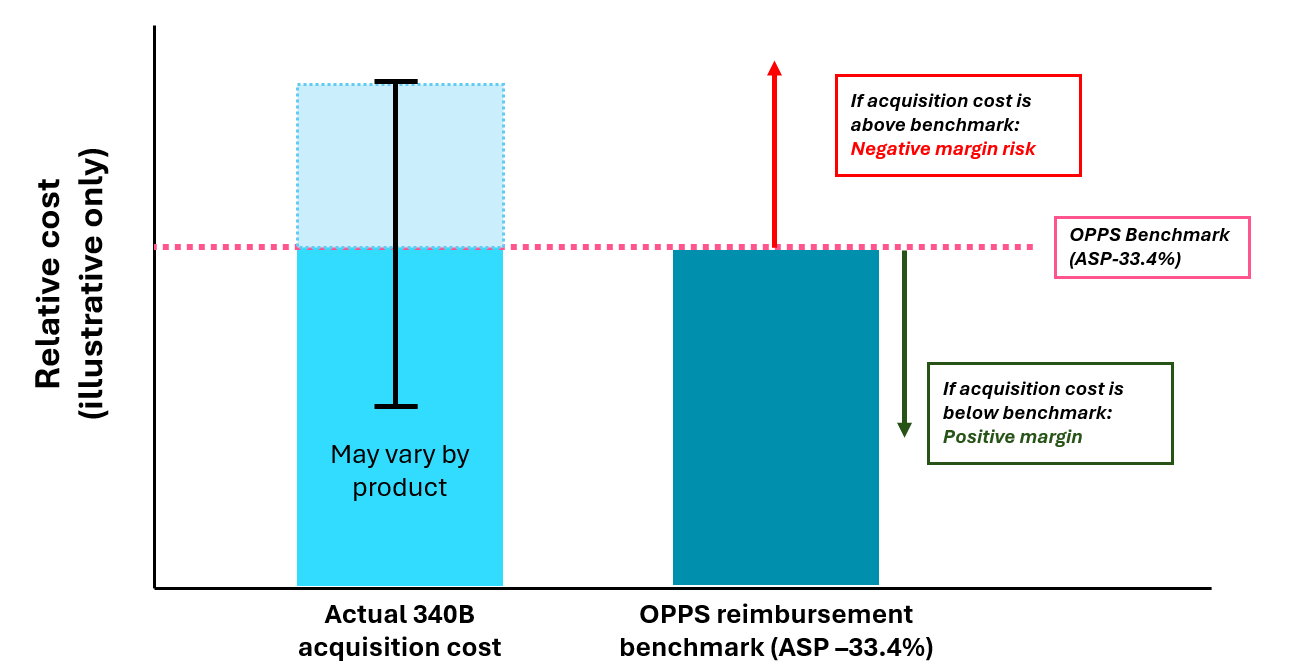
The core issue is not whether ASP – 33.4% approximates acquisition cost on average, but whether applying that benchmark broadly creates negative margins for certain products or hospitals.
Figure 1. Relationship actual acquisition cost and ASP – 33.4% reimbursement benchmark
We’ve seen this before
In 2018, CMS reduced Medicare payment for certain 340B-acquired drugs under the OPPS, from the statutory default of generally ASP +6% to ASP -22.5%. In 2022, the Supreme Court ruled that CMS could not apply differential payment rates to 340B hospitals without first conducting a survey of hospitals’ acquisition costs, prompting CMS to return payment for 340B-acquired drugs to generally ASP +6% beginning in 2023.
CMS subsequently established the OPPS Drug Acquisition Cost Survey in late 2025 and collected hospital acquisition-cost data from January through April 2026. Drawing on those results, in the CY 2027 OPPS rule CMS proposed to reimburse separately payable 340B-acquired drugs at ASP –33.4%. The agency’s goal is to more closely aligning Medicare payment with hospitals’ reported acquisition costs.
Hospitals may respond by reassessing their purchasing strategies
If reimbursement falls below the acquisition cost of a 340B-acquired drug, hospitals may reconsider how they purchase and manage that product. Depending on the therapy and available alternatives, hospitals could purchase outside of 340B, reassess formulary positioning, seek additional sub-ceiling discounts, or favor clinically comparable products with more favorable reimbursement.
Hospitals’ responses are likely to vary across therapeutic areas. Products in highly competitive classes may already carry deeper discounts that keep acquisition costs below the proposed reimbursement benchmark, while products that are offered at the ceiling price but with limited sub-ceiling discounts may have less room between acquisition cost and reimbursement and therefore face greater exposure to negative margins.
These pressures could extend across the 340B market. Hospitals, manufacturers, and other channel stakeholders may need to reassess whether existing contracting, discounting, and purchasing arrangements remain sustainable and consider changes that preserve both access and provider economics.
Payment pressure could shift purchasing, formulary, and channel incentives
As 340B reimbursement becomes more closely tied to average acquisition costs, relative drug pricing economics could play a larger role in hospital decision-making, particularly when clinically comparable alternatives are available. Products that preserve a positive margin may become more economically attractive, while products with negative margins could face greater formulary or utilization pressure.
Financial pressure could also affect how a therapy is acquired and delivered to patients. Where operationally and legally possible, providers facing negative net cost recovery under hospital buy-and-bill may be incentivized to explore specialty-pharmacy fulfillment or other channels that reduce direct exposure to drug acquisition cost. However, payer benefit design, specialty-pharmacy and site-of-care policies, and regulatory and operational requirements could limit the extent of such shifts.
These dynamics could become even more complex for drugs subject to Part B maximum fair price (MFP) effectuation beginning in IPAY 2028. Under CMS’s draft guidance, manufacturers may provide access to the MFP prospectively or retrospectively, with CMS proposing Standardized Default Refund Amounts (SDRA’s) as a proxy for provider acquisition cost under retrospective effectuation. If reimbursement and MFP refunds do not keep pace with provider acquisition costs as market prices evolve, pressure on provider net cost recovery could compound the effects of lower 340B reimbursement. This could further increase incentives to reconsider purchasing arrangements or specialty-pharmacy fulfillment.
The interaction of 340B reimbursement and Part B MFP effectuation could make drug economics a more prominent factor in treatment and channel decisions, particularly when clinically comparable alternatives exist.
To explore these dynamics in more detail, connect with us.