
thought leadership
2027 supplemental benefits differ across Medicare Advantage plan types
By Robin Duddy-Tenbrunsel, Kirsten Stryker Blasch, Nadia Mercado | October 30, 2026
New analysis of 2027 MA plan offerings finds that the largest differences in supplemental benefits across plan types are in transportation, meals, nutrition, and other targeted offerings.
Written by:

Principal


Background
Most Medicare Advantage (MA) plans offer supplemental benefits that are not available in traditional, fee-for-service (FFS) Medicare (e.g., dental, vision, and hearing benefits). Benefit availability and design vary by plan and may be subject to eligibility requirements, coverage limits, cost sharing, or other access rules. Plan benefit design data are generally released in the fall before the Medicare Annual Enrollment Period, when beneficiaries can compare coverage options for the following year.
Analysis of 2027 supplemental benefit offerings
Avalere Health compared non–Special Needs Plans (non-SNPs), Chronic Condition Special Needs Plans (C-SNPs), and Dual Eligible Special Needs Plans (D-SNPs). Non-SNPs are MA plans without Special Needs Plan enrollment restrictions (i.e., plans available to all beneficiaries eligible for MA). C-SNPs are designed for people with qualifying chronic or disabling conditions, while D-SNPs are designed for people who are eligible for both Medicare and Medicaid.
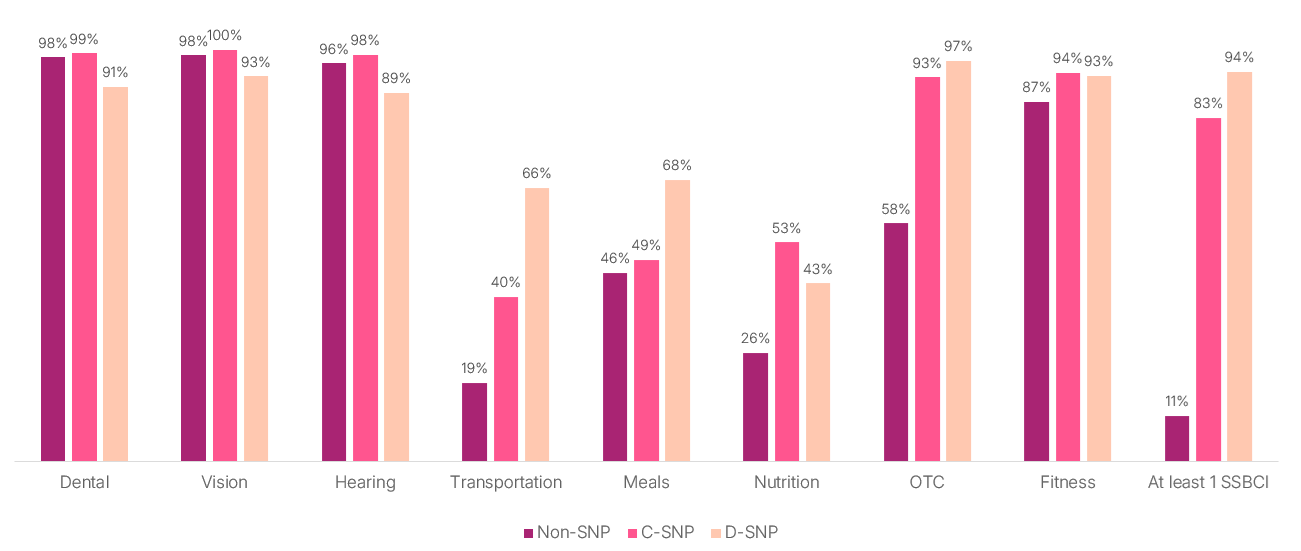
Figure 1. Share of MA plans offering selected supplemental benefits, by plan type, 2027
Broadly available supplemental benefits
In 2027, dental, vision, hearing, and fitness benefits will remain common across non-SNPs, C-SNPs, and D-SNPs, although availability will vary slightly by plan type. C-SNPs will have the highest share of plans offering dental (98.8%), vision (99.6%), and hearing (98.4%), followed closely by non-SNPs. D-SNPs will have a somewhat lower share of plans offering these benefits: 90.7% for dental, 93.2% for vision, and 89.2% for hearing. Fitness benefits will also continue to be widely available, with C-SNPs (94.1%) and D-SNPs (93.4%) exceeding non-SNPs (87.1%).
More variation across targeted benefits
Differences will be larger for benefits related to transportation, food, and other day-to-day needs. In 2027, 66.2% of D-SNPs will offer transportation benefits, compared with 39.8% of C-SNPs and 18.9% of non-SNPs. Meal benefits will follow a similar pattern: they are offered in 68.2% of D-SNPs, compared with 48.7% of C-SNPs and 45.7% of non-SNPs. The share of C-SNPs offering transportation and meal benefits in 2027 will be notably lower than in 2026, declining by 13.4 and 12.0 percentage points, respectively.
Nutrition benefits will be most common among C-SNPs: 53.0% will offer a nutrition benefit, compared with 43.1% of D-SNPs and 26.2% of non-SNPs. This is a 7.1-percentage-point increase in the share of C-SNPs offering nutrition benefits from 2026. Over-the-counter (OTC) benefits will remain substantially more common among SNPs than among non-SNPs, with 96.9% of D-SNPs and 93.0% of C-SNPs offering an OTC benefit, compared with 57.6% of non-SNPs.
The largest differences will be in Special Supplemental Benefits for the Chronically Ill (SSBCI). SSBCIs are benefits that plans may offer to eligible enrollees with chronic illnesses and that may address health-related or other needs permitted under Medicare rules. In 2027, 94.2% of D-SNPs and 83.2% of C-SNPs will offer at least one SSBCI, compared with 11.0% of non-SNPs. The share of C-SNPs offering at least one SSBCI will decline by 11.2 percentage points from 2026, while the corresponding D-SNP share will increase by 5.7 percentage points.
Considerations for stakeholders
By supporting beneficiaries’ holistic health needs, certain supplemental benefits may be cost-effective to plans in the long term. Avalere Health found that MA beneficiaries who participated in a fitness program in 2021 had a relative reduction in annual medical costs of 14% when compared to a matched cohort of fee-for-service (FFS) Medicare beneficiaries and 6% when compared to a matched cohort of MA beneficiaries without access to the program.
As plan benefit designs evolve, beneficiaries may consider how eligibility requirements and coverage limits vary by plan and may impact the availability of supplemental benefits that they use particularly important for transportation, meals, nutrition, OTC items, and SSBCI. The year-over-year changes may also show that benefit designs evolve in response to enrollee needs, operational considerations, and market conditions.
Differences in benefit availability may provide helpful context for the broader Medicare beneficiary experience of care, particularly where transportation, nutrition, and other practical supports intersect with access to care and treatment adherence. Availability alone does not indicate a benefit’s generosity, use, or impact on health outcomes or costs.
Methodology
Avalere Health analyzed the Landscape file released by CMS in September 2026 and the plan benefit package (PBP) files released by CMS in October 2026. The Landscape file was used to determine Medicare Advantage plan availability and SNP type in 2027. Avalere Health excluded Employer Group Waiver Plans, Medicare Medicaid plans (MMPs), PACE plans, Cost Plans, medical savings account plans (MSAs), and plans in select US territories are excluded from this analysis. For the 2027 plans identified, Avalere Health identified plan offerings of select supplemental benefits using the PBP files.
Separately, Avalere Health conducted a comparison of the medical costs of beneficiaries enrolled in MA that participated in selected fitness program to those of the matched comparison of beneficiaries enrolled in FFS Medicare. Avalere Health accessed MA encounter and FFS claims data through CMS’s Chronic Condition Warehouse Virtual Research Data Center available under a data use agreement with CMS.
Using the MA encounter and FFS claims data, Avalere Health identified FFS and MA beneficiaries with 36 months of continuous enrollment from 2020 to 2022 and excluded beneficiaries with end-stage renal disease. Avalere Health employed a propensity score model to match MA beneficiaries that participated in the selected fitness program with similar FFS beneficiaries. The propensity score model required an exact match on variables including gender, race, dual eligibility, original reason for entitlement, census region, and rurality. Additional variables in the propensity score model included age, hierarchical condition category score, chronic condition flag, and median household income.
Avalere Health evaluated the effect of participation in the select fitness program using a difference-in-differences approach to compare annual beneficiary medical costs in the twelve months pre- and post-initiation of fitness program participation. To determine medical costs for MA beneficiaries, Avalere Health developed a standardized fee as a function of FFS services and the corresponding allowed costs and inflated costs to a single reference year. The difference-in-differences comparison for annual medical cost was measured using an estimate based on linear regression modeling.