
thought leadership
Examining variation in gene therapy access across states
By Maggie Kruger, Nicole Letourneau, Margaret Scott | August 27, 2024
Written by:



The Medicaid Drug Rebate Program requires state Medicaid programs to cover outpatient drugs produced by participating manufacturers for all medically accepted indications. In general, covered outpatient drugs include those administered in an outpatient setting as well as drugs administered in an inpatient setting when paid for separately. However, within these federal requirements, states are granted flexibility to administer their Medicaid programs. As a result, approaches to Medicaid coverage, management, reimbursement, and financing of innovative therapies varies among states.
To understand this variability, Avalere Health analyzed gene therapy coverage, reimbursement, management, and access across 12 state Medicaid programs (Arizona, California, Florida, Indiana, Louisiana, Massachusetts, Michigan, North Carolina, New York, Oregon, Texas, Washington). The analysis examined Medicaid coverage and reimbursement policies for four gene therapies that were approved between 2017 and 2023. The research was conducted for each state’s Medicaid fee-for-service (FFS) program and for the largest managed care organization (MCO) in each state. In addition, Avalere assessed state management approaches, use of innovative financing, treatment center availability, out-of-state coverage policies, and coverage of ancillary services (e.g., travel, lodging).
Medicaid coverage and management policies for innovative therapies
State management of gene therapies:
States may determine which entities—the state fee-for-service program or managed care organizations—are responsible for coverage and management of gene therapies.
- Carve in: In eight of the assessed states (Arizona, Florida, Louisiana, Massachusetts, North Carolina, New York, Oregon, Texas), gene therapies are carved into managed care organization contracts, meaning the managed care organization is responsible for covering and bearing risk for gene therapy costs. In two of these states (Arizona, Texas), the state mitigates managed care organization’s risk by reimbursing them for some or all of the cost of certain high-cost drugs and services.
- Carve out: The remaining four states (California, Indiana, Michigan, Washington) carve gene therapies out of managed care organization contracts and manage them entirely through fee-for-service. The specific drugs subject to these carve outs vary from state to state. For example, Indiana carves out certain high-cost drugs from managed care organization contracts while California carves out all care for certain high-cost conditions (e.g., hemophilia).
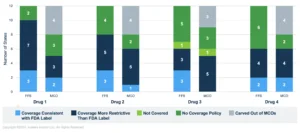
Clinical Coverage Policies: Clinical coverage policies set coverage requirements for gene therapies, and those requirements inform patient access. Across all assessed state fee-for-service programs, managed care organization plans, and drugs, clinical coverage criteria are publicly available in approximately two-thirds of instances. Of these publicly available policies, about two-thirds contain requirements that are more restrictive than the products’ FDA labels (Figure 1), which could limit coverage to fewer patients than defined by the FDA. These requirements are typically based on products’ clinical trial inclusion and exclusion criteria. In addition, although states are required to cover outpatient drugs of manufacturers that participate in the Medicaid Drug Rebate Program, one state (IN) has published a non-coverage policy for a gene therapy. In some instances, managed care organization coverage policies are more restrictive than those implemented by the state fee-for-service program. This practice has drawn the attention of federal agencies and lawmakers, as federal regulation requires managed care organization coverage policies to be no more restrictive than fee-for-service policies.
Figure 1: State coverage of assessed gene therapies
Reimbursement for gene therapies across Medicaid fee-for-service programs and managed care organizations
Generally, states reimburse for gene therapies either using a bundled payment methodology (e.g., diagnosis related group) or following a methodology that reimburses for the cost of the gene therapy separately from other costs (e.g., patient care). Bundled payments reimburse for all services provided during an encounter at a set rate based on patient factors (e.g., diagnosis) and do not account for the number or types of services provided. The rates paid under these methodologies typically do not factor in the price of high-cost therapies and therefore may not always cover the costs of purchasing and delivering gene therapies.
More than half (56%) of fee-for-service programs assessed in this analysis pay for gene therapies provided in the inpatient setting using bundled payments. Bundled payments are less common in the outpatient hospital setting, with 90% of assessed fee-for-service programs using methodologies that pay for gene therapies provided in the outpatient setting separately from other costs.
State adoption of innovative contracting
States are increasingly exploring innovative financing approaches to manage drug costs. Of the 12 assessed states, 10 have CMS-approved state plan amendments to allow value- or outcomes-based rebate agreements. In addition, at least five of the evaluated states (Arizona, Louisiana, Massachusetts, Michigan, Washington) have entered into innovative contracts with pharmaceutical manufacturers. Three of these innovative contracts (Arizona, Massachusetts, Michigan) are for gene therapies and are structured as outcomes-based agreements in which the manufacturer will provide additional rebates if certain clinical outcomes are not met.
Ancillary service and out of state coverage
Gene therapies are typically administered in designated treatment centers or centers of excellence. For the gene therapies researched, there are no treatment centers available in many states, meaning many gene therapy patients would need to travel out of state to access care. While all states must cover out-of-state care and non-emergency medical transportation, the accessibility of information on this coverage varies. In addition, information on state coverage of ancillary services (e.g., lodging and meal support) to support travel for care is often limited. For example, while comprehensive information on travel, lodging, and meal support is available from Indiana Medicaid, patient-facing resources from California Medicaid focus more on transportation.
Considerations for patient access
Variation in gene therapy management strategies can create differences in patient access across states. In states and managed care organizations without published clinical coverage policies, patients may face delays in care, particularly if a case-by-case review is needed. When published coverage policies are more restrictive than a product’s FDA label, a patient may not receive coverage, despite being eligible for a gene therapy per the product’s label. While states are generally required to cover all of an Medicaid Drug Rebate Program-participating manufacturer’s products there are not specific federal requirements that either set timelines for clinical coverage policy publication or require that coverage criteria align with FDA labels. The absence of federal requirements can lead to differences in timelines of access for patients across states.
Differences in reimbursement methodologies across states may also have implications for patient access. Bundled payments often do not account for the cost of gene therapies, which could limit provider uptake and subsequently patient access. Separate payment policies, such as the one required under CMS’s Cell and Gene Therapy Access Model, aim to evaluate the link between provider reimbursement and gene therapy uptake and access.
State policies related to out-of-state treatment and ancillary services coverage are also likely to influence patient access, particularly when the limited availability of treatment centers requires patients to travel to receive care. While Medicaid programs must cover out-of-state care and non-emergency medical transportation, requirements around the publication of patient-facing and accessible information on these benefits are limited.
Methodology
Avalere assessed gene therapy management approaches across 12 state Medicaid programs. Using publicly available resources (e.g., state Medicaid program websites), Avalere identified clinical coverage and reimbursement policies for four on-market gene therapies. For each state, Avalere Health researched the state fee-for-service program and the largest managed care organization. In instances where the same managed care organization parent organization was the largest managed care organization in two states, the second largest managed care organization was selected in one of the states. Information is current as of April 2024.
Connect with us
To learn more about management of innovative therapies and the impacts for your business, connect with us.
Funding for research provided by the Pharmaceutical Research and Manufacturers of America (PhRMA). Avalere maintained editorial control.