
thought leadership
Medicare Advantage plans increase use of step therapy for Part B drugs
By Amanda Tripp, Gina Krupp | May 24, 2024


Background
A variety of specialty drugs are used in the treatment of rheumatoid arthritis to control its progression and symptoms. These include disease modifying anti-rheumatic biologics, which play a pivotal role in improving the prognostication of the disease and patient quality of life. Currently, rheumatoid arthritis biologics may be covered either under Medicare Part B or Part D, depending on whether the drugs are administered within an outpatient care setting or self-administered by a patient. In Part B fee-for-service, all Food and Drug Administration-approved rheumatoid arthritis drugs are covered when reasonable and necessary, permitting physicians to select the treatment that they believe will be most effective at allowing a patient to meet their treatment needs and goals. In contrast, Medicare Advantage plans are increasingly using various tools at their disposal to control utilization and spending of rheumatoid arthritis drugs.
Since 2019, the Centers for Medicare & Medicaid Services (CMS) has allowed Medicare Advantage plans to require step therapy for Part B drugs for patients beginning a new course of treatment. Medicare Advantage prescription drug plans may require patients to step through a Part D drug therapy prior to allowing a Part B drug therapy, or vice-versa, and all Medicare Advantage plans (including Medicare Advantage prescription drug plans) can require patients to step through one Part B drug before gaining access to another. CMS issued the guidance in expectation that allowing Medicare Advantage plans more flexibility in controlling Part B product utilization would enable them to negotiate more effectively with manufacturers. CMS issued final regulations, which became effective in 2020, formalizing Medicare Advantage plans’ ability to require step therapy for Part B drugs.
Despite increased plan flexibility regarding step therapy for Part B drugs, stakeholders have expressed growing concern over the potential for inappropriate denials of services as Medicare Advantage plans increasingly employ not just step therapy, but other utilization management requirements such as prior authorization. Critiques about inappropriate utilization management practices are reflected in a 2022 Department of Health and Human Services Office of the Inspector General’s report, which found that Medicare Advantage plans sometimes denied or delayed beneficiaries’ access to services, even if the requests met Medicare fee-for-service coverage requirements.
In response to concerns, in February 2024 CMS finalized policies that increase transparency surrounding Medicare Advantage plans’ prior authorizationPA requirements for non-drug items and services and shorten the timeframe in which a prior authorization decision must be made. This rulemaking underscores an increased urgency across stakeholders and CMS’s willingness to promote transparency and oversight of the Medicare Advantage program. In the most recent rule, however, the agency stopped short of exploring specific guardrails related to step therapy and drug access.
Analysis of utilization management strategies
Avalere Health evaluated Medicare Advantage plans’ annual medical policy and formulary restrictions data for 22 rheumatoid arthritis drugs covered under Medicare Advantage from 2018 to 2023.
Use of step therapy by Medicare Advantage plans
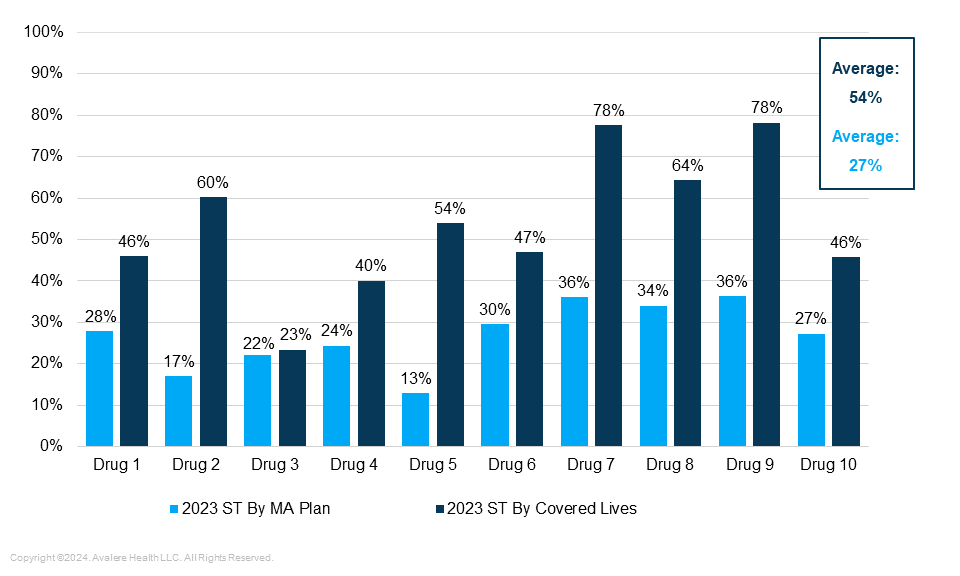
- Since 2019, when CMS gave Medicare Advantage plans the ability to use step therapy for Part B drugs, the proportion of enrollees in plans that apply step therapy to the analyzed set of rheumatoid arthritis drugs has increased steadily every year. By 2023, more than half of Medicare Advantage enrollees (54%) were in plans that applied step therapy to the analyzed set of 10 commonly used physician administered rheumatoid arthritis biologics under the medical benefit (Figure 1).
- For two of the products studied, 78% of enrollees were in Medicare Advantage plans that applied step edits to these products in 2023.
- Across Medicare Advantage plans that required step therapy for rheumatoid arthritis drugs under the medical benefit, an average of 27% of enrollees were in plans requiring two or more steps—but that share could be as high as 44% of enrollees for specific drugs.
Figure 1: Percent of plans and enrolled lives with step therapy for a given rheumatoid arthritis drug under medical benefit, 2023
Cross-benefit management
- Medicare Advantage prescription drug plans that manage drug access through a cross-benefit approach mostly required stepping over a Part D drug before gaining access to prescribed Part B drugs, rather than the inverse. Medicare Advantage prescription drug plans imposed step therapy restrictions that required enrollees to step through a pharmacy benefit drug before a medical benefit drug 51% of the time in 2020; this proportion fell to 40% in 2023.
- Conversely, the proportion of enrollees in Medicare Advantage prescription drug plans that required stepping over Part B rheumatoid arthritis drugs to get access to Part D products remained minimal and largely unchanged, rising from 4% in 2018 to 6% in 2023.
Utilization management for biosimilars
- MA plans increased step therapy protocols referencing biosimilars since the commercialization of key products starting in 2020. By 2023, about a quarter of Medicare Advantage plans on average applied step therapy protocols to Part B rheumatoid arthritis biosimilars.
Key considerations
The share of beneficiaries in Medicare Advantage relative to fee-for-service continues to increase, calling attention to access to Medicare-covered items and services by Medicare Advantage plans. These findings offer insight into how plans currently apply utilization management tools on some medical benefit drugs and how the application of utilization management has changed since the effectuation of CMS’s guidance.
The increased use and changing application of step therapy in Medicare Advantage have implications for beneficiary medication access. Changes in utilization management in Medicare Advantage have come under increased scrutiny in recent years, with some stakeholders calling for increased protections regarding utilization management criteria to ensure that beneficiaries in Medicare Advantage plans have the same access to clinically appropriate care as they would in fee-for-service and do not face disruptions, delays, or adverse events. In particular, the growing trend to manage rheumatoid arthritis drugs between Part B and Part D has called into question whether CMS has the appropriate tools to review cross-benefit utilization management and ensure it is in line with fee-for-service coverage requirements and it sufficiently accounts for individual patient needs.
Looking ahead, the Inflation Reduction Act (IRA) includes several policies that could impact Medicare Advantage plan liability, including Part D benefit redesign and Medicare negotiation, which may lead Medicare Advantage plans to find new ways to manage drug spending and control costs. As the IRA continues to be implemented, stakeholders and policymakers should monitor closely the balance between Medicare Advantage plan activities to manage enrollee care with the monitoring and oversight that CMS is willing to do with respect to the clinical appropriateness of cross-benefit step edits and utilization management.
Methodology
Avalere Health partnered with Clarivate to obtain formulary and policy restrictions data for coverage analyses. Drugs were categorized as a medical benefit (i.e., physician administered drugs) or pharmacy benefit (i.e., self-administered drugs) based on CMS spending data and drug administration.
Dive deeper
To learn more about the impact and prevalence of utlization management in Medicare, as well as the interaction of IRA implementation with Medicare Advantage, connect with an Avalere Health expert today.
Funding for this research was provided by PhRMA; Avalere Health retained full editorial control.
Additional reporting for this article was provided by Luke Frazier, Milena Sullivan, and Ekemini Isaiah.