
thought leadership
Part D plans continue to tighten coverage, increase coinsurance and prior authorization in 2027
By Brook Getachew, Kylie Stengel, Amanda Tripp, Yiwen He, Juliana Tin | October 23, 2026
Coverage for top brand drugs continues to decline in 2027 as Part D plans also further shift toward coinsurance and greater use of prior authorization.
Written by:

Associate Principal


Managing Director


On October 15, the Centers for Medicare & Medicaid Services (CMS) released the 2027 Part D formulary files. Taken with the plan landscape files, these data offer insight into how Part D plans are continuing to shift their formulary and benefit strategies in response to the Inflation Reduction Act (IRA) and growing in Part D utilization and spending trends.
Drug coverage
Overall coverage for top brand drugs continues to decrease in 2027, with some variety across drug and plan type. For the top 100 brand drugs by Medicare Part D spending, coverage is declining in 2027 by four percentage points for Medicare Advantage Prescription Drug plans (MA-PDs) and by three percentage points for standalone Prescription Drug Plans (PDPs). Even with this decline, MA-PDs still cover a greater share of top brand drugs than PDPs (Figure 1).
Figure 1: Average percentage of top 100 brand drugs covered vs. not covered among MA-PDs and PDPs, 2026 vs. 2027
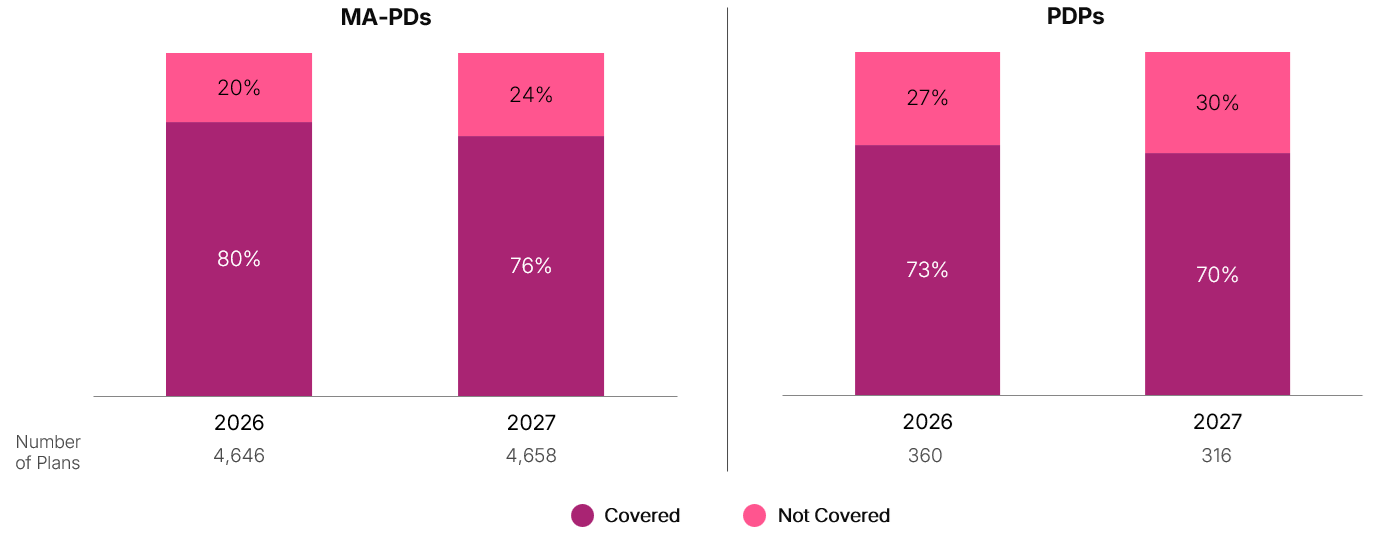
In contrast, coverage of the top 100 generic drugs is increasing from 85% to 87% for PDPs and remains steady at 89% for MA-PDs between 2026 and 2027.
Cost sharing
Shifts in cost sharing continue to be the most notable changes in Part D formulary management. In 2027, 86% of MA-PDs and nearly all PDPs will have three or more coinsurance tiers, a 23 percentage point increase for MA-PDs and an 11 percentage point increase for PDPs from 2026 (Figure 2). In 2024, 57% of PDPs had three coinsurance tiers and 79% of MA-PDs had one or no coinsurance tiers.
Figure 2: Percentage of MA-PDs and PDPs by number of coinsurance tiers, 2026 vs. 2027
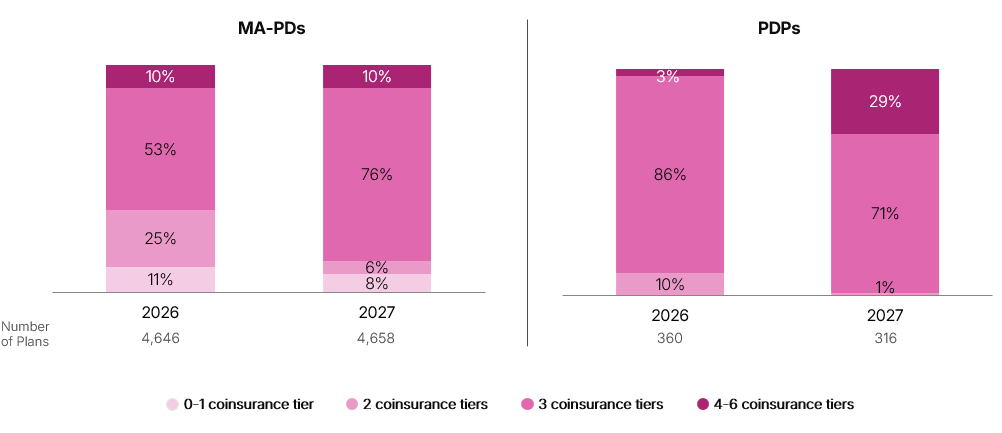
With the significant growth in the number of coinsurance tiers, most covered drugs now require coinsurance across both PDPs and MA-PDs. From 2026 to 2027, the average share of covered drugs placed on coinsurance tiers increased from 63% to 69% for MA-PDs and from 79% to 82% for PDPs. Since 2024, the share of covered drugs placed on coinsurance tiers has increased by approximately 39 percentage points for MA-PDs and by 13 percentage points for PDPs.
Utilization management (UM)
Use of prior authorization (PA) for covered brand drugs is continuing to increase in 2027, rising by an average of two percentage points for both PDPs and MA-PDs. There were similar increases in PA from 2025 to 2026. Rates of PA remain slightly higher for PDPs than MA-PDs (Figure 3).
Figure 3. Average percentage of covered brand drugs by utilization management tool among MA-PDs and PDPs, 2026 vs. 2027
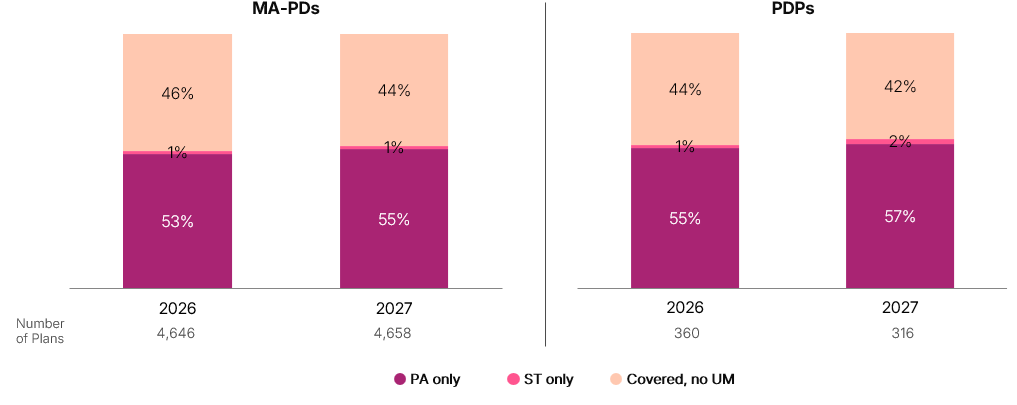
Among the top 100 covered brand drugs, use of PA was even higher, increasing from 65% in 2026 to 68% 2027 for PDPs and from 64% to 65% for MA-PDs. Although the formulary files capture whether utilization management applies to a drug, they do not reflect the specific criteria. Prior Avalere Health analyses have found that utilization management criteria have become more restrictive over time, including prior authorization that is more restrictive than Food and Drug Administration label requirements and requirements for pre-requisite therapy as part of prior authorization.
Variations by therapeutic area, plan type, and region
As plans respond to the evolving Part D market and utilization trends, previous Avalere Health analyses have shown that changes in Part D formulary management may be more pronounced for certain drugs and therapeutic areas, with variation by sponsor, plan type, and region.
Changes in plan offerings and premiums, alongside shifts in formulary management, will continue to shape beneficiary access, contracting strategies, and competitive positioning in 2027 and beyond. With access to both historical Part D formulary data and monthly updates, Avalere Health’s new interactive formulary dashboard tool, Part D Formulary 360, allows stakeholders to examine ongoing changes in Part D access and inform market strategies.
To learn more about the evolving Part D market and its implications, or to explore Avalere Health’s Part D Formulary 360 tool, connect with us.
Methodology
Avalere Health used the Part D formulary files released by CMS. The top 100 generic and brand drugs by Part D spending were, accessed through an agreement with CMS, wherein Avalere Health has access to CMS’s Chronic Condition Warehouse Virtual Research Data Center. Results exclude territories, Employer-Group Waiver Plans, Cost plans, Medicare-Medicaid Plans, and Program of All-Inclusive Care for the Elderly plans.