
thought leadership
PDP instability accelerates in 2027 as plan options shrink and premiums rise
By Kylie Stengel, Robin Duddy-Tenbrunsel, Kirsten Stryker Blasch, Amanda Tripp, Yiwen He | September 30, 2026
Average standalone PDP premiums are climbing 50% in 2027, as PDP availability falls another 12% and the number of LIS benchmark plans drops to just 59.
Written by:





On September 28, the Centers for Medicare & Medicaid Services (CMS) released the 2027 Medicare Advantage (MA) and Part D landscape files. This annual data release offers a first look at MA and Part D plan offerings for 2027, as the Inflation Reduction Act (IRA) provisions continue to shape the market.
Background
The IRA has reshaped the Part D market, with the redesign of the Part D benefit in 2025 and introduction of negotiated maximum fair prices (MFPs) in 2026. Part D plan bids for Calendar Year (CY) 2027, which encompass both Medicare Advantage Prescription Drug Plans (MA-PDs) and standalone Prescription Drug Plans (PDPs), reflect a market that is still adjusting to these changes, along with shifting pharmacy and medical utilization trends, MA payment policy updates, and shifts in competitive strategies.
Plan premiums
CMS announced that in 2027 it would discontinue the Part D Premium Stabilization Demonstration for PDPs, which ran for the past two years. This change is likely driving more substantial premium increases for PDPs in 2027 compared to previous years.
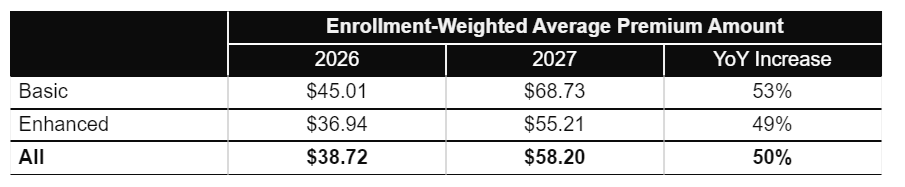
For non-low-income subsidy (LIS) beneficiaries choosing to remain in their current plan, Avalere Health estimates that enrollment-weighted average PDP premiums will increase by 50% for plans offered in both 2026 and 2027, with a slightly higher premium increase in basic plans compared to enhanced plans (Table 1).
Table 1: Enrollment-weighted average PDP premiums for non-LIS enrollees by plan type, 2026 vs. 2027 (plans available in both 2026 and 2027)
Not all enrollees will experience the same change in premiums. Among non-LIS beneficiaries in PDPs, 21% are in plans that will have a monthly premium increase of $30 or more in 2027, while 27% are in plans that will have a monthly premium change of less than $5, including 14% of enrollees in PDPs who will have a premium decrease of $1 to $5. Similar to previous years, 78% of non-LIS MA-PD enrollees are currently in a non-Special Needs Plan (non-SNP) MA-PD with a $0 Part D premium that will remain at $0 in 2027. However, 10% of MA-PD beneficiaries are in a plan that will have a Part D premium increase of $10 or more in 2027.
PDP and MA-PD plan offerings
Part D market dynamics under the IRA, along with broader Medicare market shifts, continue to affect the availability of plan options, particularly for PDPs and LIS benchmark PDPs.
The number of PDPs is decreasing by 12%, falling from 360 plans in 2026 to 316 plans in 2027. This is a 55% reduction in the number of PDP options since 2024, when the out-of-pocket cap at the catastrophic threshold was first implemented under the IRA. The number of LIS benchmark plans is also falling substantially, from 88 plans in 2026 to only 59 plans in 2027, a 33% decrease from 2026 (Figure 1).
2027 marks the first time in which three states (FL, NV, SC) will have no basic PDPs that meet the 2027 LIS benchmark amount. In these states, it is likely that the basic PDP with the lowest premium in the region will default to the LIS benchmark plan option. Additionally, in 14 states, LIS beneficiaries will only have one benchmark plan option. Overall, Avalere Health estimates that 1.84 million LIS beneficiaries are currently enrolled in LIS benchmark PDPs that will no longer qualify as benchmark plans in 2027.
For MA-PDs, the number of non-SNP MA-PDs is declining by 5%, from 2,967 MA-PDs in 2026 to 2,827 in 2027. Meanwhile, the number of SNPs is increasing by 8%, from 1,701 SNPs in 2026 to 1,834 in 2027 (Figure 1). Most of the growth in SNPs is driven by Chronic-SNPs (C-SNPs), which are increasing by 36% to 744 plans in 2027, while the number of Dual-Eligible SNPs (D-SNPs) is decreasing by 7%, to 932 plans in 2027.
Figure 1. Number of Part D plans by plan type, 2024–2027
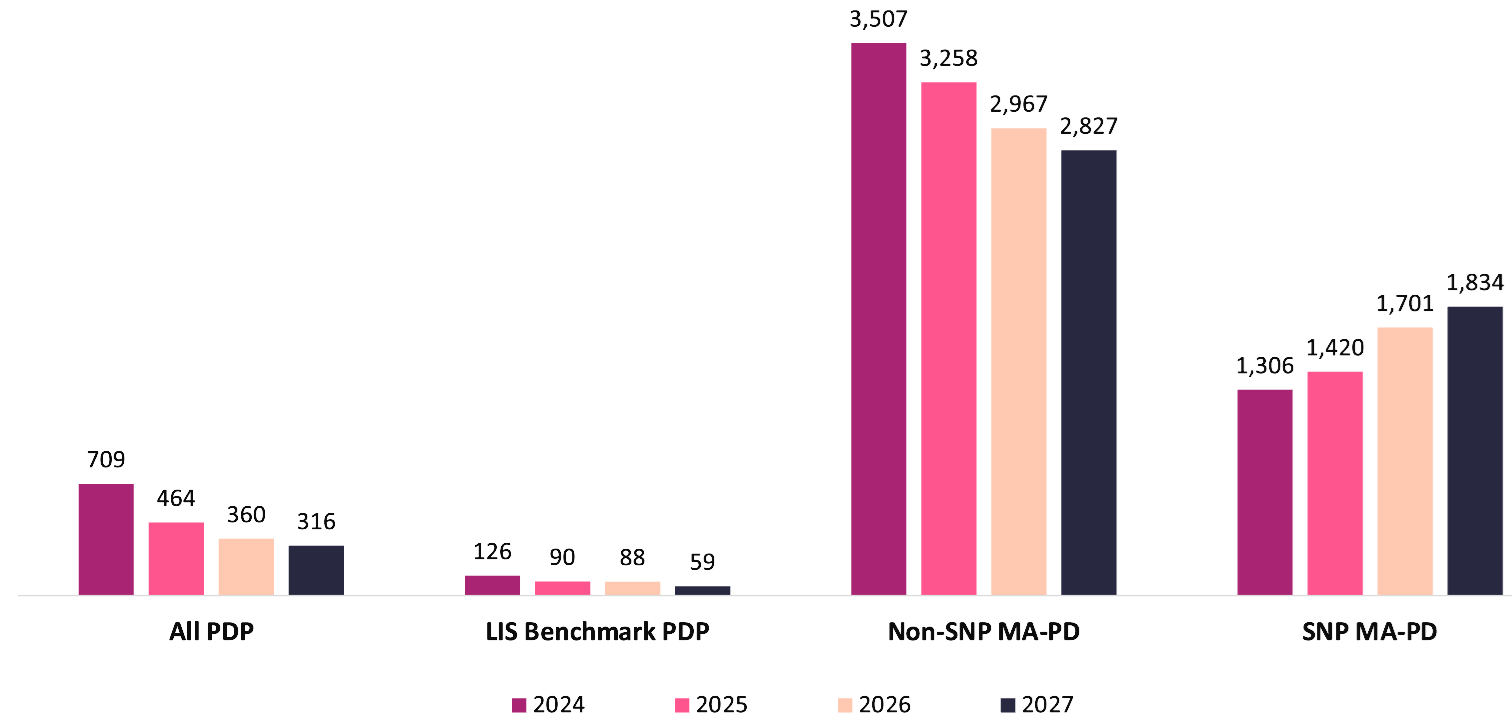
Note: MA-PD numbers exclude MA plans without drug coverage, Medicare-Medicaid Plans (MMPs), Program of All-Inclusive Care for the Elderly (PACE) plans, Cost Plans, Medicare Medical Savings Account (MSA).
Plan sponsors continue to reduce enhanced Part D plan options, with the number of enhanced PDPs declining by 15% in 2027, following a 34% reduction from 2025 to 2026 and a 40% reduction from 2024 to 2025. The number of enhanced non-SNP MA-PDs is also decreasing, with 7%, 9%, and 5% reductions each year between 2024 and 2027.
Potential effects on beneficiary enrollment and access
Substantial changes in PDP plan availability and premiums, combined with the expectation for continued adjustments to Part D formularies and MA plan benefits, are likely to drive beneficiary enrollment choices for the 2027 plan year. In a separate analysis, Avalere Health found that 20% (8.7 million) of non-LIS beneficiaries switched Part D plans from 2025 to 2026. Among those who switched plans, 80% chose a different plan offering within the same plan type, while 20% moved to a different plan type (e.g., from a PDP to an MA-PD). Plan premiums are likely a driving factor of these enrollment decisions, as beneficiaries who switched plans from 2025 to 2026 had average premiums that were 43% lower in their new plan. For LIS enrollees, the reduction in PDP benchmark options may continue to shift LIS enrollment away from PDPs to MA-PDs, including into MA-PD SNPs.
Notably for plan year 2027, CMS has published data on MA-PDs that include an optional enrollment capacity limit. Enrollment capacity limits may impact beneficiaries who are looking to enroll in an MA-PD or switch MA-PDs. Once enrollment in an MA-PD exceeds the enrollment capacity limit, beneficiaries may no longer enroll in that MA-PD. Two percent of non-SNP MA-PDs (51 plans) will include an enrollment capacity limit next year, with the average limit of 9,835 enrollees.
The upcoming release of the 2027 Part D formulary files and plan benefit package data in October will provide insight into how beneficiary access and affordability will be shaped by enrollment decisions, and differing impacts to beneficiaries based on region and plan type. Stakeholders should consider how enrollment shifts in 2027 will impact access and competitive positioning in not only 2027, but in anticipation of the 2028 contracting cycle.
For more information on how plan availability, premiums, and formularies for 2027 and beyond will impact your organization, connect with us.
Methodology
Avalere Health used the initial version of Landscape files released by CMS in September 2023–2025. PDP data for 2025 reflect numbers from CMS’s landscape file update in October 2024. Except where noted, Employer Group Waiver Plans, MMPs, PACE plans, Cost Plans, MSAs, and plans in US territories are excluded from this analysis. For calculations of enrollment-weighted average premiums, Avalere Health used enrollment data from September 2026 and assumed no beneficiaries will change plans for 2027. Enrollment-weighted average premium estimates only include plans that will be available in both 2026 and 2027. Enrollment-weighted average premium estimates reflect only non-LIS enrollees who pay the full plan premium. LIS enrollment in each plan was therefore excluded for this estimate using the 2026 LIS enrollment file. For estimates reflecting LIS enrollees, Avalere Health derived LIS enrollment at the state level by using the Plan level Part D enrollment file for PDP, Contract-Plan-State-County level Part D enrollment file for MA-PD, and the LIS plan level enrollment file released by CMS in 2026.
Analysis of plan switching from 2025 to 2026 used Medicare data through an agreement with CMS, wherein Avalere Health has access to CMS’s Chronic Condition Warehouse Virtual Research Data Center. The analysis included all non-LIS beneficiaries who were enrolled in a Part D plan in 2025 (January-December) and 2026 (January). Plan assignment for each beneficiary was determined by their latest enrolled plan in 2025 and earliest enrolled plan in 2026. Avalere Health used the Master Beneficiary Summary file and the CMS plan crosswalk file to assess plan consolidation/new contract and plan ID assignment from 2025 to 2026.