
thought leadership
Beyond dispensing: The expanding role of the pharmacist
By Kirsten Stryker Blasch, Marina Thornton, Robin Duddy-Tenbrunsel | September 30, 2026
As pharmacists take on expanded clinical, administrative, and public health responsibilities, they have begun to play a more integrated role across the health care system, connecting patients with providers, payers, manufacturers, and hospitals across the health care system.
Written by:



Pharmacists play an increasingly multifaceted role in the US healthcare system that extends beyond dispensing to patient education, medication management, safety monitoring, care coordination, public health, and coverage and policy decisions. This paper maps six “domains” of pharmacist practice, using community pharmacies (i.e., brick-and-mortar pharmacies that operates in a chain or independently) as a key example of how pharmacists connect patients with providers, payers, manufacturers, and other participants in the healthcare system.
Policy landscape
Pharmacists’ role and their relationships with other healthcare entities are now at the center of an active policy debate. Building on the passage of the Consolidated Appropriations Act of 2026—which enacted reforms that impact pharmacy benefit managers (PBMs)—Congress is considering proposals that collectively have the potential to create major changes to structural relationships and operational practices that define how pharmacists and pharmacies function across the healthcare system.
Pharmacists’ evolving role
With approximately 90% of Americans living within five miles of a community pharmacy, pharmacists are among the nation’s most accessible healthcare professionals, often serving as a first and frequent point of clinical contact for the public. Despite this visibility, the full clinical capabilities of pharmacists are frequently unrecognized. Less visible is the important role pharmacists play across a broad and expanding range of clinical, administrative, and public health functions. They work in and with community pharmacies, hospitals, specialty and long-term care settings, PBMs, managed care organizations, and pharmaceutical manufacturers, among others.
This evolution reflects the increasingly interconnected nature of the US healthcare system. Today, pharmacists serve as a communication bridge across healthcare settings, linking patients to providers, payers to prescribers, and clinical care to public health infrastructure.
Core domains of pharmacist practice across the healthcare system
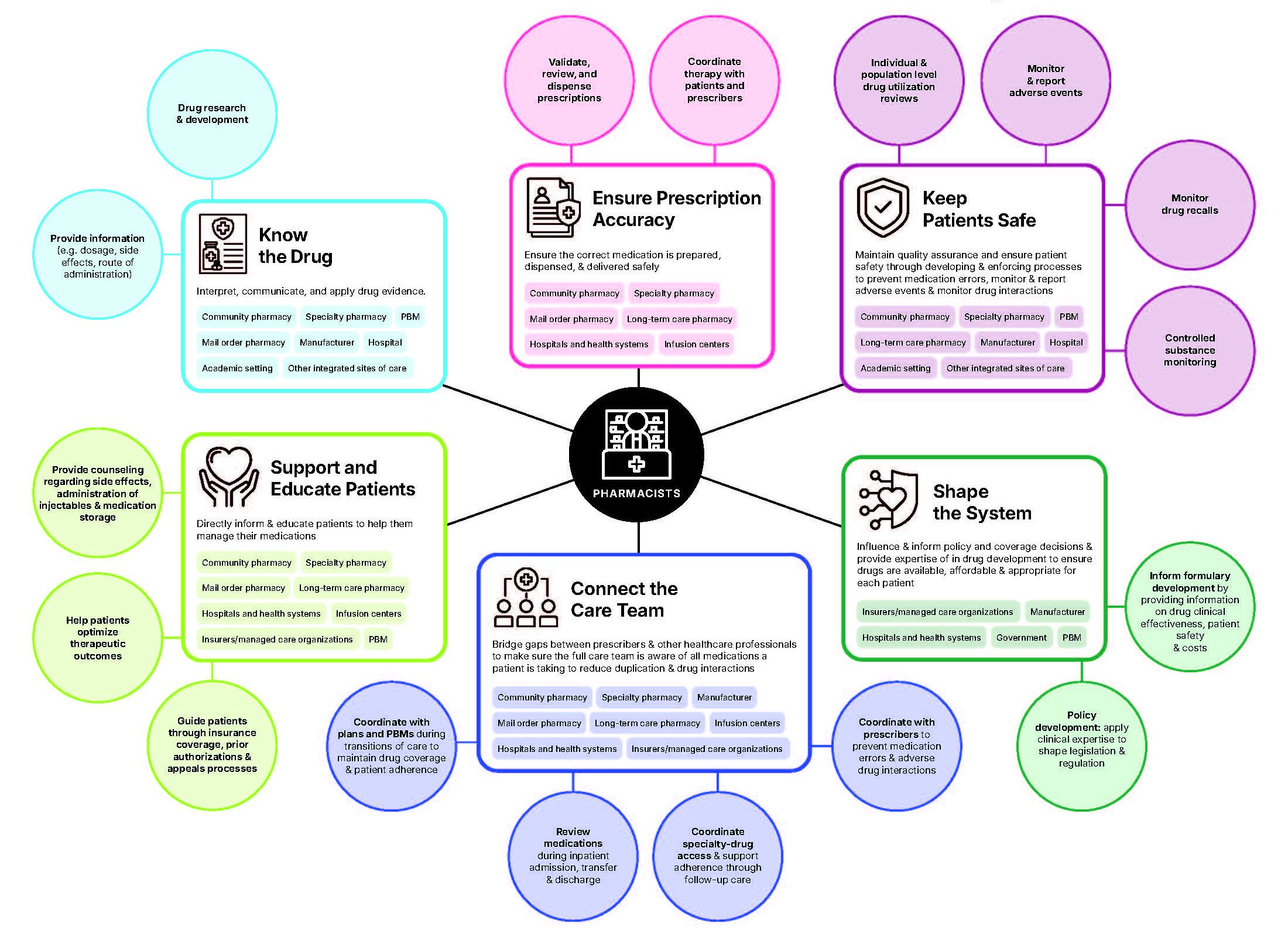
From drug development to patient care, pharmacists are present at every stage of the medication journey. Figure 1 maps six core domains of pharmacist activity across the healthcare ecosystem, illustrating how pharmacists serve patients, connect care teams, and contribute to the systems that govern drug access and safety.
Figure 1. The pharmacists’ role across the healthcare system
The role of the pharmacist extends beyond the pharmacy counter
Among the intersection points between the pharmacist and the healthcare system, perhaps the most familiar is the interaction between a patient and the pharmacist behind the counter. However, the community pharmacist’s role and impact span far beyond traditional activities like filling prescriptions.
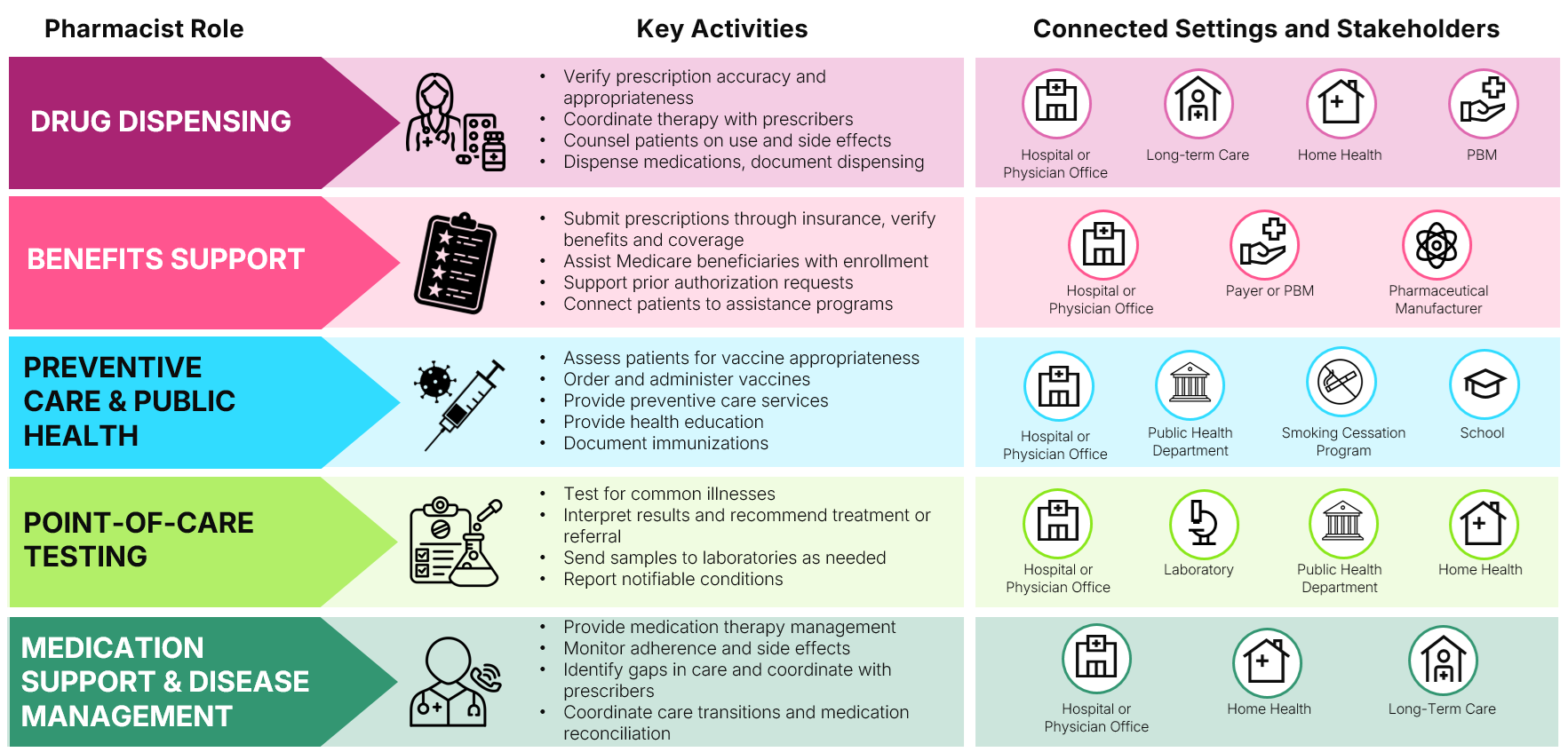
Today, pharmacists’ roles have expanded to additional clinical services that fully utilize their full expertise. The community pharmacy setting offers an illustrative glimpse into the diverse role of pharmacists in acute, chronic, and preventive care and how their role fits within the broader patient care journey:
Figure 2. Community pharmacists serve as a bridge across healthcare settings and stakeholders
As pharmacists take on expanding responsibilities across the healthcare system, their ability to access and exchange timely information across settings of care remains central to their function. Policy discussions affecting pharmacy practice and ownership structures may have implications for these information flows and should be a key consideration for policymakers.
Prepared for CVS Health. Avalere Health retained full editorial control.