
thought leadership
State-level variation in site of care for Medicare beneficiaries treated for cancer
By Amanda Tripp, Maddi Davidson, Yiwen He, Brook Getachew, Marina Thornton | October 29, 2026
Avalere Health found that oncology care patterns varied widely by state as Medicare Advantage enrollment increased, with practice growth not consistently aligning with changes in treatment volume. These differences highlight the importance of local markets and coverage type in evaluating cancer care access and payment policies.
Written by:

Managing Director



Associate Principal

Associate
Background
Cancer care delivery continues to evolve as the oncology provider landscape becomes increasingly consolidated. Broader trends in physician employment, practice ownership, and provider affiliation have shifted care delivery away from independent physician practices and toward hospital- and corporate-owned entities. Prior research by Avalere Health, conducted for the Physicians Advocacy Institute, found that physician employment and practice ownership have steadily moved away from independent practice towards more vertically integrated entities from 2018 to 2026. As of January 2026, 82% of physicians were employed by hospitals or corporate entities, and 63% of physician practices were owned by hospitals and corporate entities.
Over this same period, notable shifts in Medicare enrollment have occurred. From 2022 to 2025, the proportion of Medicare enrollees enrolled in Medicare Advantage (MA) increased from 46% to 54%. A similar shift in enrollment from traditional (fee-for-service [FFS]) Medicare to MA occurred for beneficiaries undergoing cancer treatment as well.
Oncology care delivery can take place in community or hospital outpatient department (HOPD) settings, making broader ownership and affiliation trends especially relevant to oncology. For the purposes of this research, community oncology practices are intended to represent non-hospital, independent oncology clinics. Practices were categorized based on claims billing patterns and organization details. Ownership and affiliation changes drive site of care shifts, which have important implications for Medicare spending, beneficiary cost sharing, provider access, care coordination, and ongoing policy discussions regarding site-neutral payments. MA plan network arrangements may also influence where and how care is received.
Understanding variations in oncology site of care and differences in how FFS and MA beneficiaries access care can help stakeholders assess how changes in provider ownership and market structure affect Medicare beneficiaries and the delivery of cancer care.
Analysis approach
Avalere Health analyzed the primary site of care for Medicare beneficiaries treated for common cancers and categorized beneficiaries by whether their care was delivered in the community or HOPD setting. The analysis also examined variation in oncology site of care across states and compared patterns among beneficiaries enrolled in Medicare FFS and MA. FFS claims and MA Encounter data from 2022 – 2025 were used to compare patterns in oncology care. Given that the most recent MA Encounter data at the time of analysis were from 2023, Avalere health projected MA volume through 2025 based on treatment trends in the FFS population and shifts in enrollment at the county level.
Findings
Shifts in the availability of oncology practices
The number of community and hospital-based oncology practices increased by an average of 0.5% per year between 2022 and 2025, while the number of practice sites (or distinct locations) grew by 1.1% per year. Changes in the number of practices varied by state. For example, in Nevada, the number of oncology practices increased by 3% per year, on average, while in Louisiana, the number of practices declined by 1% per year between 2022 and 2025.
The variation in the availability and growth of oncology practices by state suggests that local market dynamics may shape where beneficiaries receive oncology care. Potential contributors include differences in the availability and structure of community practices, hospital ownership and affiliation, provider consolidation, rurality, referral patterns, and local provider networks. The analysis did not assess the extent to which each of these factors contributed to the differences observed.
Geographic variation in beneficiary access to oncology care
Medicare beneficiaries receiving cancer treatment accessed care in both community and hospital-based practices. Between 2022 and 2025, the number of MA beneficiaries receiving cancer treatment is projected to have increased by an average of 5% annually, while the number of FFS beneficiaries receiving cancer treatment decreased by an average of 1.4% annually. These trends reflect the broader shift in Medicare enrollment from FFS to MA.
Within each coverage type, trends in beneficiary volume varied across states and between community and hospital-based practices. Avalere Health compared each state’s average annual growth rate with the corresponding national rate for each coverage type and practice setting. Rates within 1 percentage point of the national benchmark were considered similar.
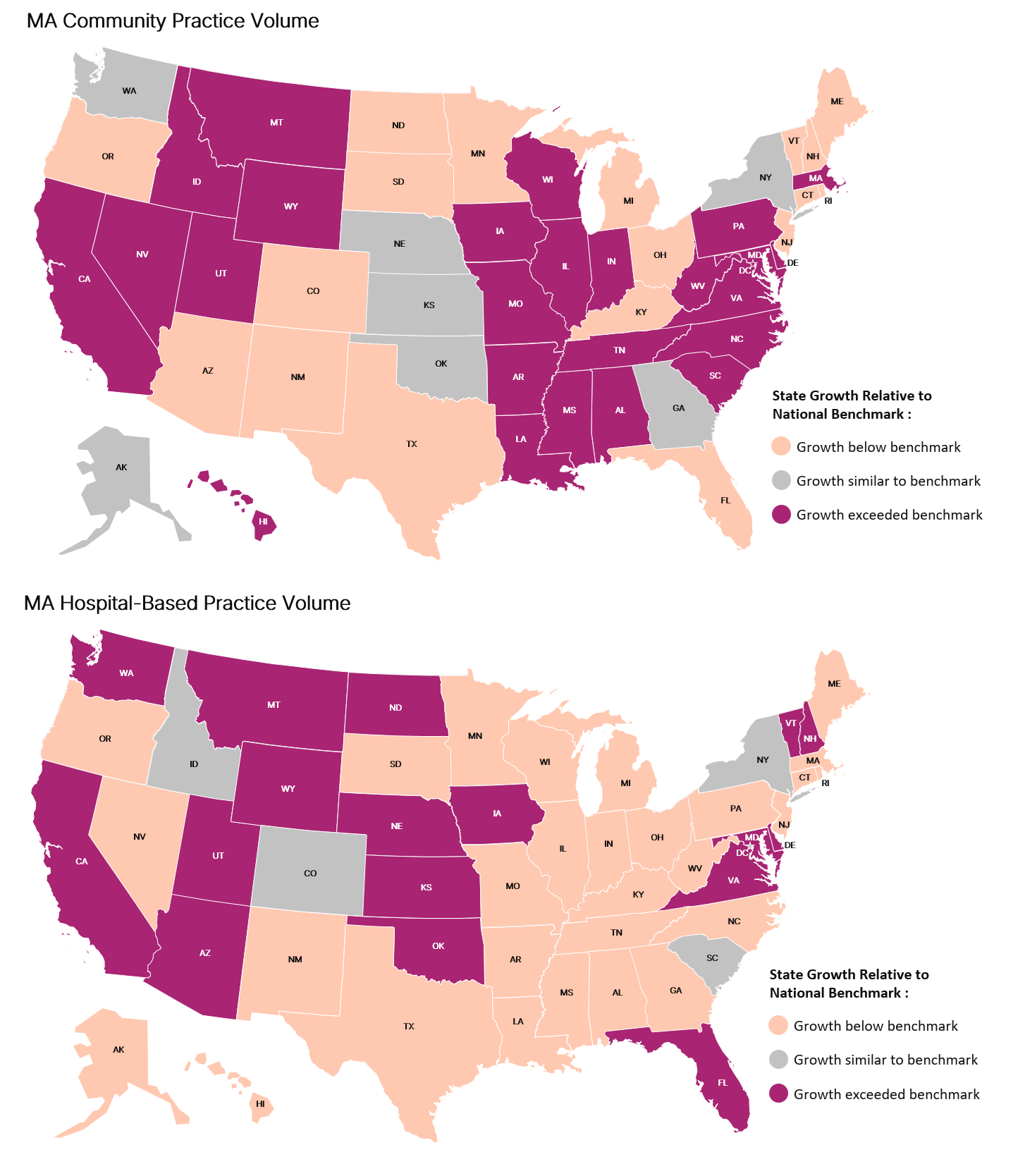
Among MA beneficiaries attributed to community practices, projected growth exceeded the national benchmark in 26 states and DC, was similar in seven states, and was below the benchmark in 18 states. Among those attributed to hospital-based practices, projected growth exceeded the national benchmark in 18 states, was similar in five states and DC, and was below the benchmark in 28 states.
Figure 1. Average annual growth in MA beneficiaries undergoing cancer treatment at the state level relative to national growth, 2022-2025
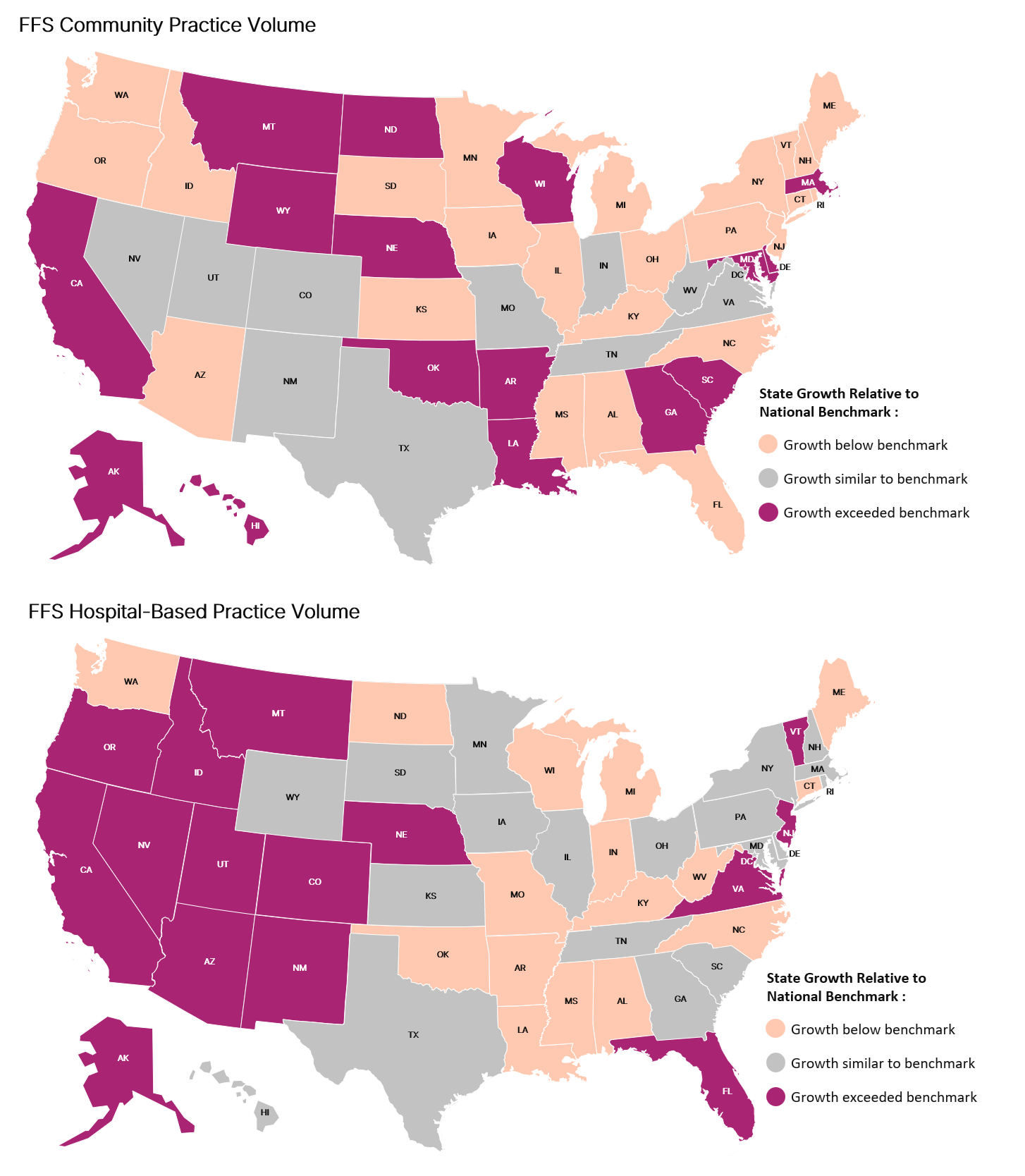
FFS beneficiary volume also showed substantial variation. Among beneficiaries attributed to community practices, the rate of change was above the national benchmark in 17 states and DC, similar in 10 states, and below the benchmark in 24 states. For hospital-based practices, the rate was above the national benchmark in 15 states, similar in 20 states and DC, and below the benchmark in 16 states. Because the FFS population receiving cancer treatment declined nationally, a rate above the national benchmark could represent a smaller decline rather than an increase in beneficiary volume.
Figure 2. Average annual growth in FFS beneficiaries undergoing cancer treatment at the state level relative to national growth, 2022-2025
Taken together, these findings illustrate how state-level oncology practice availability and Medicare coverage type interact in important ways. States with increases in community-based practices did not necessarily experience corresponding increases in the number of FFS or MA beneficiaries receiving care in those practices. The same was true for hospital-based practices, suggesting that changes in practice counts alone do not fully correspond to shifts in where beneficiaries receive oncology care.
Policy implications
State-level variation in cancer care site of service is important for policymakers and stakeholders to consider when evaluating Medicare enrollment and payment policies, provider consolidation, site-neutral payment proposals, and beneficiary access to care across states and sites of service.
As oncology practices are increasingly affiliated or owned by hospitals or other corporate entities, the continued monitoring of site-of-care patterns can help assess how market changes affect Medicare beneficiaries receiving cancer treatment.
Understanding the differences in site-of-care between FFS and MA beneficiaries across states is also important as MA enrollment continues to grow and plan networks play a larger role in shaping access to oncology providers.
Methodology
Avalere Health identified Medicare beneficiaries that were treated for one of 10 common cancers (gastroesophageal, colorectal, lung, breast, ovarian/endometrial, prostate, kidney/renal, lymphoma, multiple myeloma, chronic/acute leukemia) from 2021 to 2023. The analysis used Medicare FFS claims and MA Encounter data, assigning them to a primary cancer care setting based on observed oncology-related services, as well as the provider setting where the majority of relevant services occurred. Settings were categorized as either community practice or HOPD.
Avalere Health projected MA patient volume through 2025 based on treatment trends in the FFS population and shifts in enrollment at the county level. This analysis was descriptive and did not account for clinical complexity, cancer type, stage of treatment, treatment modality, provider availability, or beneficiary socioeconomic characteristics, except where specified.
Analyses in this publication were conducted using Medicare data from 2022-2025 through an agreement with CMS, wherein Avalere has access to CMS’s Chronic Condition Warehouse VRDC Data.