
thought leadership
IRA negotiation strategy: Projecting drug selection through MA and FFS spending dynamics
By Kate Davidson, Arka Ghosh, Annie Song, Brooke Fruman | October 30, 2026
Analysis of negotiation-eligible drugs indicates significant year-to-year variation in total negotiated spend, with Part D contributing more dollars and therapies to negotiation than Part B. Despite the inclusion of Part B therapies, there are fewer than 20 drugs in IPAYs 2032 and 2033 that exceed the minimum spend threshold requirement.
Written by:




Associate Principal
Background
The Medicare Drug Price Negotiation Program (MDPNP) directs the HHS Secretary to negotiate prices for certain single-source, high-spend products that lack generic/biosimilar competition. Each January, CMS publishes a list of selected drugs for the Initial Price Applicability Year (IPAY) that will be negotiated. The third negotiation cycle (IPAY 2028) was the first in which Medicare Part B drugs became eligible for negotiation and when Part C drugs were used in CMS selection criteria.
This new dynamic could alter multiple aspects of negotiation, including the total spending eligible for negotiation and the composition of selected drugs. Policymakers are actively considering reforms to MDPNP, the broad implications of which Avalere Health explores here.
A critical component of understanding potential reforms is to first understand how current MDPNP provisions impact drug selection and spending, to do so Avalere Health used a proprietary MDPNP forecast model to analyze the composition of drugs selected for negotiation over the next five IPAYs.
Findings
- Total spend on negotiation-eligible drugs is projected to vary significantly year to year, ranging from $15 billion in IPAY 2030 to $46 billion in IPAY 2029.
- This variation is driven by a couple of outliers. Once outlier drugs are removed from the analysis, it is evident the median spend per negotiated drug is declining over time.
- Medicare Part D dominates both in spending contribution and total number of eligible drugs. IPAY 2033 has the largest number of Part B drugs, with 7 eligible for negotiation.
- Despite the inclusion of Part B and Part D drugs, a significant number of drugs do not meet the minimum spending threshold requirement in IPAYs 2032 and 2033.
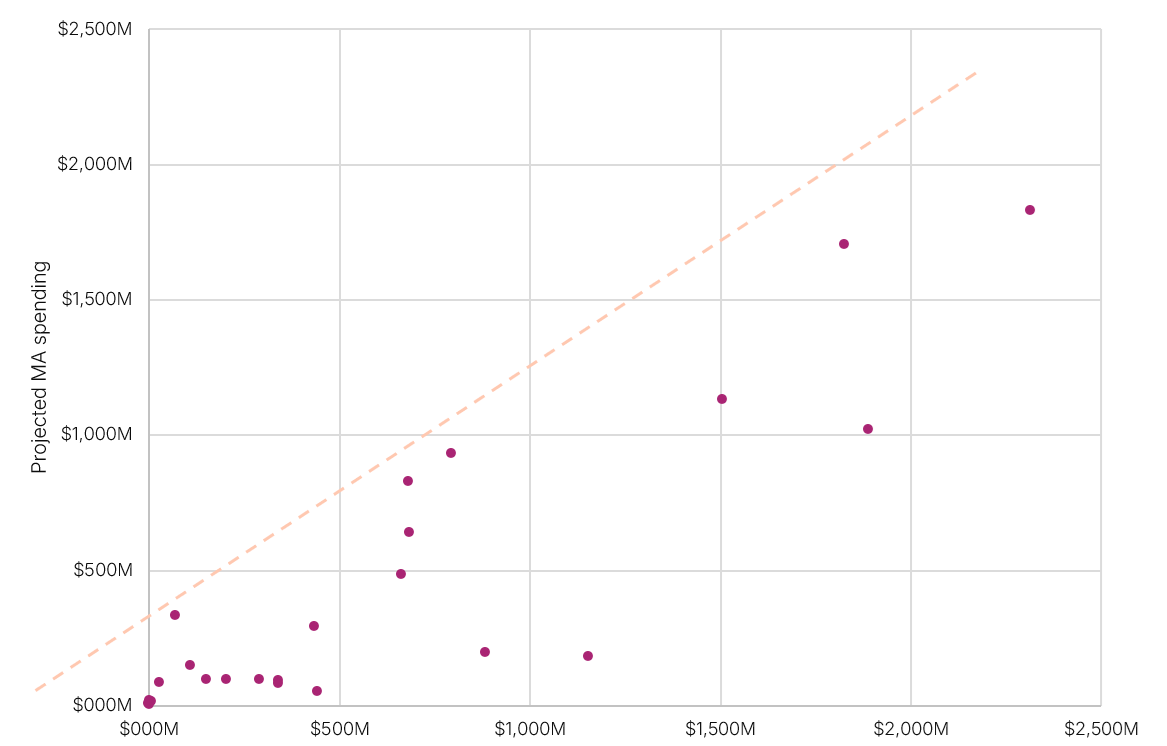
- For drugs with Part B spending, fee-for-service (FFS) spending exceeds MA spending in the majority of instances, with MA contribution ranging from 10% to 85% across selected drugs.
Click here for a detailed overview of Medicare spending for drugs likely to be selected in IPAYS 2029-2033.
Figure 1. Projected Part B spending by product in the FFS and Medicare Advantage benefits
Interested in learning more? Connect with us to understand how Avalere Health supports clients through the entire IRA negotiation process from preparation through effectuation.
Methodology
Avalere Health used Medicare data through an agreement with CMS, wherein Avalere Health has access to data from CMS’ Chronic Conditions Warehouse Virtual Research Data Center, including:
- 100% Medicare FFS Part B claims
- 100% Part D prescription drug event data
- 100% Medicare Advantage (MA) encounter data
Avalere Health also used additional data sources for its proprietary MDPNP forecast model, including publicly available information from the Food and Drug Administration to identify details relevant to a drug’s eligibility for Medicare price negotiation under the IRA.
Based on MA encounter data availability, Avalere Health projected forward the latest available MA data to the same period as that for FFS Part B claims. Because MA encounter data does not include MA plan actual contracted rates, Avalere Health estimated MA payments by applying corresponding CMS-published payment limits for each drug to estimated MA utilization.
Disclaimer
The analysis relies on Medicare data sourced from the Centers for Medicare & Medicaid Services’ Virtual Research Data Center (VRDC Data). Avalere relies upon the accuracy, and completeness of the VRDC Data without inquiry and makes no assurances or warranties in relation to the accuracy or completeness of the VRDC Data. CMS retains ownership of the use of VRDC Data, and the use of such data is subject to the terms of Avalere’s agreement with CMS and CMS rules.
Michael Ciarametaro also contributed to this article.