
thought leadership
Changing the number of years to eligibility for Medicare negotiation significantly affects targeted drug spending
By Arka Ghosh, Annie Song, Kate Davidson, Brooke Fruman | October 30, 2026
Avalere Health evaluated three potential scenarios in which time-on-market eligibility criteria for drugs in the MDPNP would alter the amount of Medicare drug spending targeted by the program.
Written by:




Associate Principal
Background
The Medicare Drug Price Negotiation Program (MDPNP) requires a drug to be on the market for a certain amount of time to be eligible for negotiation: at least seven years for a small molecule product and 11 years for biologics. It selects the top 20 drugs based on Medicare spending for each IPAY, as detailed in its eligibility criteria. Gross drug spend for a selected drug must be at least $200 million, inflated to the respective year.
The recent Democratic Senate Finance Committee Request for Information: Commonsense Policy Options to Lower Drug Prices for Patients requested proposals to allow the HHS Secretary “to negotiate more drugs each year” and “negotiate prices earlier in drug product lifecycles and when such negotiations should occur on small molecule and biologic drugs.” Avalere Health sought to understand how changes to time-on-market eligibility and minimum spend threshold requirements under MDPNP would affect impacted drug spending.
Building on another analysis projecting Medicare spend under current policy, Avalere Health examined three alternative scenarios for changes to time-on-market eligibility criteria: (1) Reducing time-on-market requirements by two years, (2) Reducing time-on-market biologic eligibility requirements to match those of small molecules, and (3) Increasing time-on-market small molecule eligibility requirements to match those of biologics. In addition, Avalere Health considered an alternative scenario in which time-on-market eligibility requirements remained unchanged while the inflation-adjusted floor was reduced from $200 million to $100 million. Avalere Health used its proprietary MDPNP forecast model to determine the potential impacts of the above changes.
Findings
- Reducing eligibility requirements by two years and reducing biologic time on market to match small molecules increase the total spend impacted by MDPNP, while increasing small molecule time on market to match biologics reduces total spend impacted by MDPNP.
- Avalere Health estimates that setting the number of years to eligibility at five for small molecule drugs and nine for biologics would increase estimated Medicare spending on drugs selected for IPAYs 2029 – 2033 by $22 billion (Figure 1). However, this policy significantly increases eligible drug spend in IPAYS 2029 and 2030 and reduces eligible drug spend in IPAYs 2032 and 2033, with a small increase in eligible drug spend in IPAY 2031. The pattern remains the same when estimated Part B spending on Medicare Advantage (MA) enrollees is excluded (Figure 2).
- Setting the number of years to eligibility at seven for both small molecules and biologic products would increase estimated spending on selected drugs by nearly $17 billion. As in the scenarios above, this results in spending increases in IPAYS 2029 and 2030 and there are mostly decreases in IPAYs thereafter.
- Setting the number of years to eligibility at 11 for both small molecule and biologic products would decrease estimated spending on selected drugs by $52 billion. The greatest change occurs in IPAY 2032, with a $33 billion decrease in eligible spending.
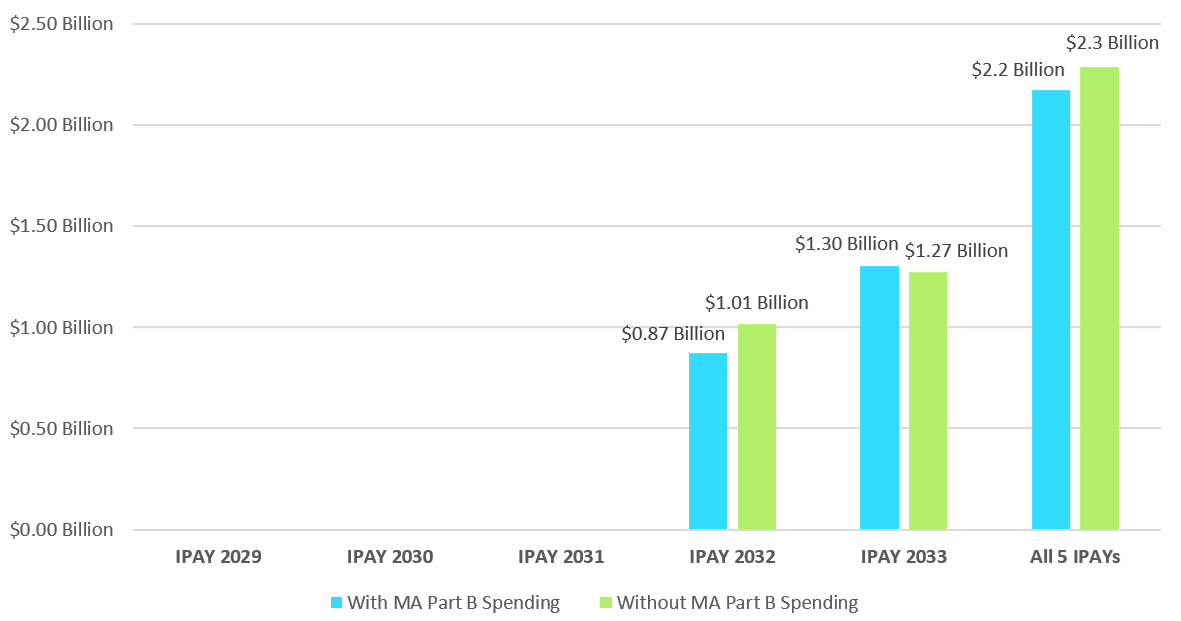
- Compared to changes in time-in-market eligibility requirements, changes in the spending floor have minimal impact. Reducing the inflated floor from $200 to $100 million increases eligible spending by $2 billion across the five years. The first three years show no impact, while eligible spending increases by about $1 billion in both IPAYs 2032 and 2033.
Figure 1. Change in projected Medicare spending on drugs identified for IPAYs 2029 – 2033 under current and alternative scenarios
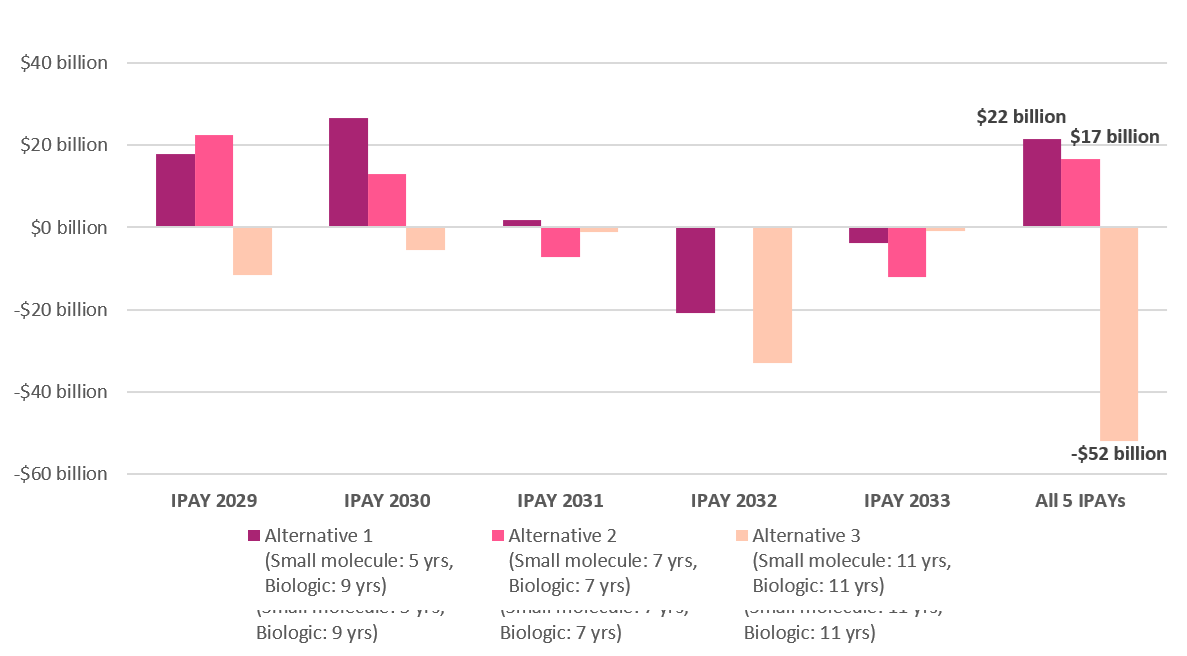
Figure 2. Change in projected Medicare Spending on Drugs Identified for IPAYs 2029 – 2033 under current and alternative scenarios (excluding Part B spending for MA enrollees)
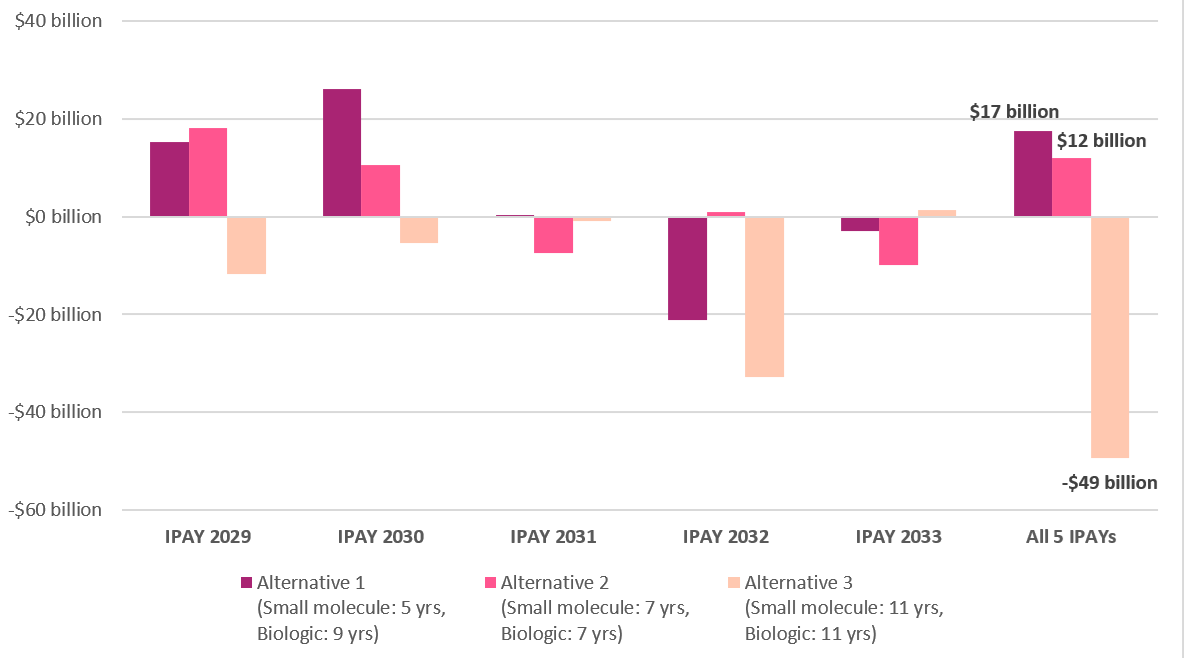
Figure 3. Projected Medicare spending on drugs in the top 20 list that are below the minimum spending threshold for IPAYs 2029 – 2033
Learn more
These findings on the likely effects of potential changes to the MDPNP eligibility criteria have important implications for pharmaceutical manufacturers, including changes to a product’s life cycle. To learn more about how Avalere Health can support your strategic planning around drug selection under the MDPNP and IRA negotiations, connect with us.
Methodology
Avalere Health used Medicare data through an agreement with the CMS, wherein Avalere Health has access to data from CMS’ Chronic Conditions Warehouse Virtual Research Data Center, including:
- 100% Medicare fee-for-service Part B claims
- 100% Part D prescription drug event data
- 100% Medicare Advantage (MA) encounter data
Avalere Health also used additional data sources for its proprietary MDPNP forecast model, including publicly available information from the Food and Drug Administration to identify details relevant to a drug’s eligibility for Medicare price negotiation under the IRA.
Based on MA encounter data availability, Avalere Health projected forward the latest available MA data to the same period as that for FFS Part B claims. Because MA encounter data does not include MA plan actual contracted rates, Avalere Health estimated MA payments by applying corresponding CMS-published payment limits for each drug to estimated MA utilization.
Disclaimer
The analysis relies on Medicare data sourced from the Centers for Medicare & Medicaid Services’ Virtual Research Data Center (VRDC Data). Avalere relies upon the accuracy, and completeness of the VRDC Data without inquiry and makes no assurances or warranties in relation to the accuracy or completeness of the VRDC Data. CMS retains ownership of the use of VRDC Data, and the use of such data is subject to the terms of Avalere’s agreement with CMS and CMS rules.
Michael Ciarametaro also contributed to this article.