
thought leadership
Attainment of QP status under MACRA varies substantially by physician specialty
By Shelby Harrington, Tim Collins, Amanda Tripp | October 28, 2026
An analysis of 2024 Quality Payment Program data finds that access to higher Medicare conversion factor updates varies by specialty, reflecting differences in practice affiliation and opportunities to participate in Advanced Alternative Payment Models.
Written by:



The Medicare Access and CHIP Reauthorization Act (MACRA) established the Quality Payment Program (QPP), which requires eligible clinicians to participate in the Merit-based Incentive Payment System (MIPS) or have a substantial share of their care delivered through Advanced Alternative Payment Models (AAPMs). Clinicians who meet thresholds for the percentage of patients or payments flowing through AAPM participation become Qualifying APM Participants (QPs) and receive a higher annual Medicare conversion factor update than other QPP participants—0.75% compared with 0.25%.
While the premise of QPP appears straightforward, participation is complex in practice. Each pathway includes overlapping categories, and a clinician’s status can depend on Medicare Part B billing, patient volume, participation in specific APMs, and the reporting option selected under MIPS. Because QPP assesses participation by National Provider Identifier and Taxpayer Identification Number combinations, clinicians who bill through multiple practices may also participate differently at each organization.
Some specialists have raised concerns that achieving QP status is more challenging for them than general practitioners or medical specialties that care for populations with high-volume chronic conditions (e.g., cardiology, endocrinology) because there are fewer APM models relevant to their practice. To better understand variation in attainment of QP status, and therefore the higher conversion factor update, Avalere Health analyzed publicly available 2024 QPP participation data, provider specialty information, and Medicare Part B claims. We assessed participation across specialties, with a focus on oncology, rheumatology, gastroenterology, dermatology, and urology. Non-physician clinicians, such as nurse practitioners and physician assistants, were removed from the analysis as they do not have an associated clinical specialty documented in the public data sets.
Table 1. QPP participation among selected physician specialties
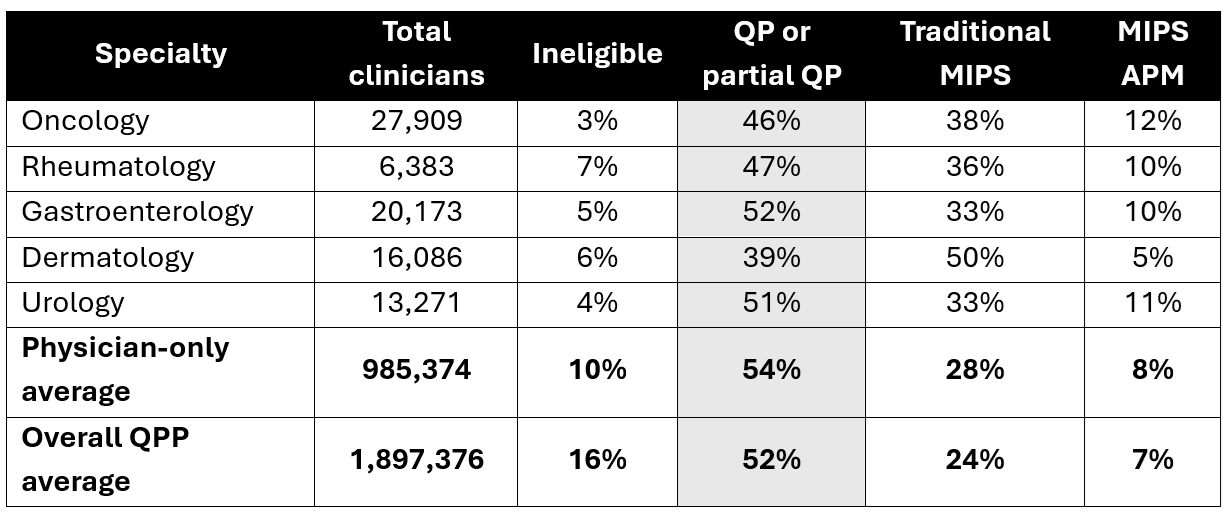
We identified three key trends:
QP status varies meaningfully by specialty. All five selected specialties had QP or Partial QP rates at or below the physician-only average. Among eligible clinicians, 59% of physicians overall achieved QP or Partial QP status, compared with 55% of gastroenterologists, 53% of urologists, 51% of rheumatologists, 48% of oncologists, and 41% of dermatologists. Because only QPs receive the higher conversion factor update, these differences result in variation across specialties in access to higher annual Medicare payment updates.
Practice affiliation and AAPM availability likely shape participation. Higher QP rates among primary care clinicians, hospital-based specialties, and some non-physician clinicians may reflect greater employment by integrated delivery networks or large physician organizations that are more likely to participate in APMs. Specialty-specific opportunities also matter. Nephrology, for example, has had dedicated AAPM options, while clinicians treating high-cost chronic conditions may be more likely to participate through accountable care organizations. By comparison, specialties with high QPP eligibility but lower QP attainment—including dermatology and oncology—may have fewer relevant Advanced APM opportunities.
Traditional MIPS remains particularly important for certain specialties. Traditional MIPS participation was substantially higher than the physician average among all five selected specialties. The difference was most pronounced in dermatology, where 50% of all clinicians and 54% of eligible clinicians participated through Traditional MIPS. Oncology also had an above-average Traditional MIPS participation rate. These patterns may reflect both limited access to relevant Advanced APMs and differences in the proportion of clinicians practicing independently rather than through larger health systems or physician networks.
These findings have important implications as QPP continues to evolve. QP thresholds increased in 2025, reverted to lower levels in 2026, and are scheduled to rise again in 2027, potentially making QP status more difficult to achieve. At the same time, the planned transition from Traditional MIPS to MIPS Value Pathways will create new strategic and operational considerations. Multispecialty practices may face greater pressure to move toward AAPMs, while single-specialty practices may have new opportunities to demonstrate quality in more clinically relevant ways.
Although most eligible physicians now achieve QP or Partial QP status, clinicians’ ability to access the higher conversion factor update remains uneven. Policymakers considering the future of QPP should account for variation in AAPM availability and ensure that specialists have meaningful opportunities to participate. This is particularly important when considering the impact of specialists’ prescribing patterns for high-cost part B drugs as IRA-negotiated prices take effect for selected Part B drugs beginning in 2028. Specialists in AAPMs that include Part B drugs in their total cost of care calculations, like Medicare accountable care organizations, will be incentivized to shift their care plans towards drugs that are both lower cost and demonstrate greater success in reducing patients’ total cost of care.
Dive deeper
Avalere Health helps healthcare organizations assess the strategic and operational implications of evolving Medicare payment policy. Our experts combine policy, data, and market analysis to support participation strategy, payment model evaluation, and preparation for changes to QPP, MIPS, and Advanced APMs. Contact us here to learn more.