
thought leadership
Medicare Prescription Payment Plan may help enrollees facing more coinsurance in 2025
By Kylie Stengel, Shruthi Donthi | January 7, 2025


Previous Avalere Health analysis of the calendar year (CY) 2025 Part D formulary files found a substantial shift from copays to coinsurance among Part D plans. In 2025, 83% of standalone prescription drug plans will have three coinsurance tiers, an increase from the 57% in 2024. For Medicare Advantage Prescription Drug Plans, 63% will have two or more coinsurance tiers in 2025, substantially more than the 18% in 2024. This means that more Part D plans will require coinsurance on both the non-preferred drug tier and the preferred brand tier in 2025. Increased use of coinsurance, especially when enrollees may have historically faced copays, may mean that more patients may benefit from the new Medicare Prescription Payment Plan, which allows participants to spread out-of-pocket costs more evenly over the remaining months of the plan year.
Impact across top therapeutic areas
Beneficiaries taking drugs commonly placed on the non-preferred drug and preferred brand tiers are likely to be most impacted by these shifts from copay to coinsurance and may face increased cost sharing on a per prescription basis as well as potentially higher total out-of-pocket costs in 2025.
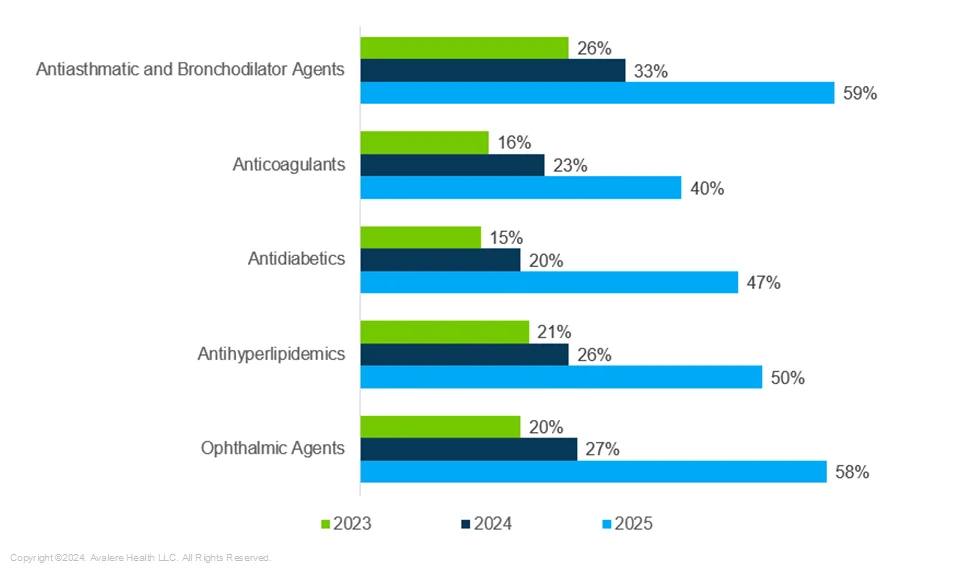
Avalere Health examined drugs in therapeutic areas with the highest Part D spending to assess which beneficiaries may be more likely to see shifts from copays to coinsurance in 2025. Across the top therapeutic areas by Part D spend, beneficiaries taking asthma medications (antiasthmatic and bronchodilator agents), anticoagulants, antidiabetics, cholesterol drugs (antihyperlipidemics), and eye medications (ophthalmic agents) will experience the largest shifts from copays to coinsurance (Figure 1). From 2023 to 2025, use of coinsurance by all Part D plans for covered drugs increased by more than 30 percentage points on average in four of these five therapeutic areas (antiasthmatic and bronchodilator agents, anticoagulants, antidiabetics, and ophthalmic agents).
Figure 1: Percentage of Part D covered drugs with coinsurance for top therapeutic areas with largest shifts from copays to coinsurance, 2023–2025
Interactions with the Medicare Prescription Payment Plan
The shift from copays to coinsurance may increase out-of-pocket costs for certain medications. While per script out-of-pocket costs may increase for some beneficiaries, the lower out-of-pocket cap in 2025 is likely to mitigate significant increases in total annual out-of-pocket costs.
For beneficiaries who will experience higher out-of-pocket costs in 2025 compared to previous years, out-of-pocket cost increases for 2025 may make it more likely that these enrollees benefit from the Medicare Prescription Payment Plan. CMS requires Part D plans to notify certain beneficiaries about the availability of the Medicare Prescription Payment Plan, including notification at the point of sale for out-of-pocket costs of at least $600 per script and before the start of the plan year based on at least $2,000 in out-of-pocket spending prior to September 2024. However, some enrollees facing higher out-of-pocket costs in 2025 may not be proactively notified about the program and its potential benefits if their historical out-of-pocket spending did not meet the $2,000 threshold laid out by CMS. Manufacturers and other stakeholders should consider how these cost-sharing changes may result in unexpected out-of-pocket costs and consider which enrollees would benefit from greater awareness of the Medicare Prescription Payment Plan.
Looking ahead to 2026, the first set of maximum fair prices under the Medicare Drug Price Negotiation Program will also go into effect. Across all Part D plans, seven of the first ten selected drugs were placed on copay tiers more than 85% of the time when covered in 2023. In 2025, coinsurance is used at least 40% of the time for virtually all of the covered IPAY 2026 products. While maximum fair prices in 2026 may reduce out-of-pocket costs for products with coinsurance compared to 2025, beneficiaries could still pay more for these drugs compared to prior years, when copays were primarily used.
To learn more about the impacts of these Part D out-of-pocket changes for 2025 and beyond, connect with us.
Methodology
Avalere Health used the 2023, 2024, and 2025 Part D formulary files released by the Centers for Medicare & Medicaid Services, Prescription Drug Event data, and MediSpan for this analysis. Avalere Health used Prescription Drug Event data to identify the therapeutic areas that correspond to the top 50 brand drugs by Part D spend in 2022. Drugs were then grouped into therapeutic areas based on MediSpan GPI groupings.
Additional reporting for this article was provided by Ashley Flint.