
thought leadership
The role of comparator selection in ex-US health technology assessment and international drug pricing
By Sarah Moselle, Marina Thornton, Heather Wieffer | September 21, 2026



Avalere Health sought to better understand the comparator choices that underpin ex-US health technology assessments (HTAs), as these choices can significantly impact the assessment of relative benefits and costs, and subsequently inform price negotiations and reimbursement decisions.
We evaluated the extent to which comparators for the same product differed across countries, contrasting comparator selections by six international HTA agencies for five products. We also compared product prices across reference markets to better understand how differences in HTA approaches and local healthcare contexts may contribute to variation in pricing and reimbursement outcomes.
Key findings
Avalere Health found significant variability in the comparator products chosen by ex-US HTA bodies when assessing the same drug.
Of the five products evaluated, one of them (oncology product) was assessed by all six appraisal bodies that were surveyed; the remaining four were assessed by either four or five of the appraisal bodies.
Each drug had multiple treatment comparators available, ranging from four up to 20, and HTA bodies varied widely in which comparators they selected for their assessments.
- Comparator sets: There was no product for which all countries selected the same set of (multiple) comparator drugs.
- Individual comparators: At the individual drug comparator level, the number of cases in which all assessment bodies consistently selected a single comparator (within the broader set) ranged from 0% to 25%, further illustrating the breadth of variation in comparator selection.
Prices also varied across referenced countries, highlighting how differences in value assessment and comparator choice may contribute to differences in price. For the six products Avalere assessed, the percent difference between the lowest and highest price across the reference countries ranged from 34% for a respiratory product to 566% for a hematology-oncology product.
Several factors may contribute to cross-country variability in comparator selection, including the timing of HTAs, differences in countries’ assessment methodologies and policy frameworks, and differences in societal preferences and values that may underpin approaches to HTA and coverage and payment policy.
Background
In the US, comparator selection already plays a significant role in the Centers for Medicare and Medicaid Services’ (CMS) decision-making under the Medicare Drug Price Negotiation Program. CMS’s therapeutic alternative selection methodology for negotiations centers on clinical substitutability at the indication level per US guidelines, Medicare claims data, or clinical practice patterns.
Additionally, renewed attention to international reference pricing through Most-Favored Nation (MFN) policies and the introduction of the Global Benchmark for Efficient Drug Pricing (GLOBE) and Guarding US Medicare Against Rising Drug Costs (GUARD) Models have heightened interest in how drug prices are established in benchmark countries and the role comparator selection plays in those decisions. GLOBE and GUARD incorporate international reference pricing from a market basket of 19 countries to benchmark rebate obligations. If the US government were to formalize international reference pricing, it is essential to understand how ex-US HTA decisions incorporate local preferences and value judgments, and what their implications are for patients in the US.
Analysis approach
Avalere Health sought to better understand the comparator choices that ultimately shape price negotiation and reimbursement decisions in reference countries. Avalere Health expanded upon a 2025 analysis to further assess the extent to which comparator selection varies between countries and how those differences may affect price negotiations and reimbursement. This additional layer of analysis offers context for stakeholders into how choices made by international HTA bodies may influence foreign reference prices and the considerations associated with incorporating those prices into US policy discussions.
Avalere Health assessed the comparators selected by HTA bodies in six countries in the GLOBE and GUARD reference markets: Canada’s Drug Agency (CDA-AMC), the United Kingdom’s National Institute for Health and Care Excellence (NICE), France’s Haute Autorité de Santé (HAS), Germany’s Gemeinsamer Bundesausschuss (G-BA), Australia’s Pharmaceutical Benefits Advisory Committee (PBAC), and Switzerland’s HTA.1
Avalere Health reviewed HTA assessments across a variety of therapeutic areas (oncology, hematology, diabetes, and respiratory) to identify comparators. In total, the analysis assessed five products across four therapeutic areas. In this updated analysis, Avalere Health also included a comparison of prices for these five products across all six markets. Pricing data was retrieved from Navlin and presented in US dollars for each product across all markets.
Findings
Of the six assessments considered in this analysis, only one was formally evaluated by all five HTA bodies (Figure 1).
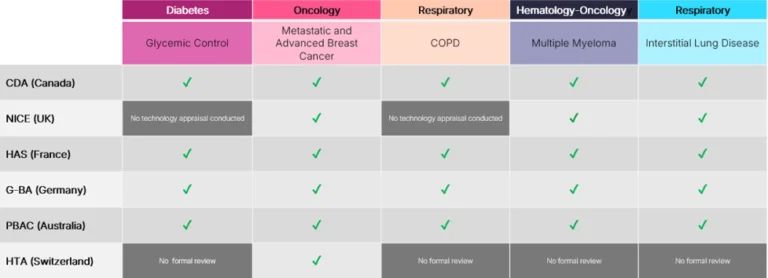
COPD: Chronic obstructive pulmonary disease Note. The text “No formal review” indicates that the HTA did not conduct a value assessment on the product. The text “No technology appraisal conducted” indicates that the product was evaluated outside of the technology appraisal program but still evaluated through a formal process that considered clinical and cost-effectiveness. Note 2: This analysis matched product/indication assessments across the five organizations to ensure consistency.
No product in this evaluation had an identical comparator set across all HTA bodies included in its comparator analysis. Instead, the results show that comparator selection varies widely across countries’ HTA evaluations. Of all five products assessed across four disease areas, a different set of comparators was chosen by each HTA.
The number of therapies identified as comparators by assessing agencies ranged from four (for the respiratory product) to 20 (diabetes product), and averaged just under 12 comparator entries listed.
When evaluating consistency at the individual comparator level (vs. comparator set), the proportion of instances in which all assessing HTA bodies listed the same product as a comparator ranged from 0% to 25% (Figure 2). Across all five case studies, only three of 59 total comparator entries, or approximately 5%, were selected by every assessing HTA body.
Figure 2. Comparator consistency for assessed products
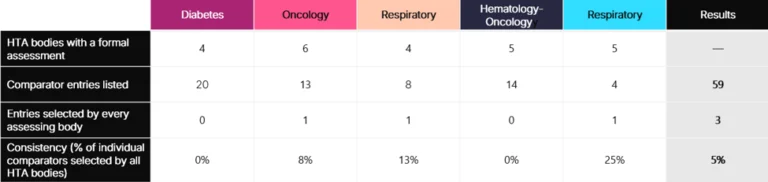
Figure 3 illustrates one example of inconsistency in comparator selection, highlighting how HTA bodies apply different approaches when defining the relevant treatment comparator landscape. Germany’s G-BA, for example, prioritizes comparators with demonstrated additional benefit relative to the drug assessed, often resulting in a different set of alternatives than those considered in other jurisdictions. Germany’s G-BA and Australia’s PBAC only used 33% of available comparators (including subsets of products within a class) compared to Canada’s CDA, which had a broad approach and used all comparators and subsets available. In the US, standard of care for diabetes increasingly emphasizes therapies with demonstrated cardiovascular and renal benefits in addition to glycemic control. Differences in whether HTA agencies abroad compare diabetes interventions against older glucose-lowering therapies or more contemporary interventions could lead to substantially different assessments of relative benefit and value.
Figure 3. Comparators used across HTAs for diabetes product
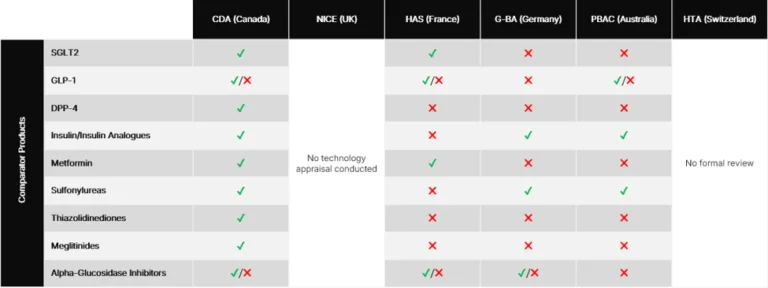
Note. Green checkmark indicates that the class or treatment was included in the country’s HTA review. Red x indicates that the class or product was not included in the country’s HTA review. Classes with both indicate that while the class overall was not included as a comparator, a subset of products within the class were included in the assessment.
Those impacts become apparent in price variations across reference markets (Figure 4), suggesting that differences in value assessment approaches may be a contributing factor in price negotiations and pricing outcomes. This underscores that international prices may reflect value assessments conducted against fundamentally different standards of care and treatment landscapes. Prices in many ex-US markets are also shaped by country-specific negotiation processes, confidential discounts and agreements, and budgetary considerations. These pricing differences likely reflect a range of market-specific factors, including variations in comparative value assessment approaches, but also generic availability and contracting negotiations that may be at play for certain drugs.
Figure 4. Price range for selected drugs
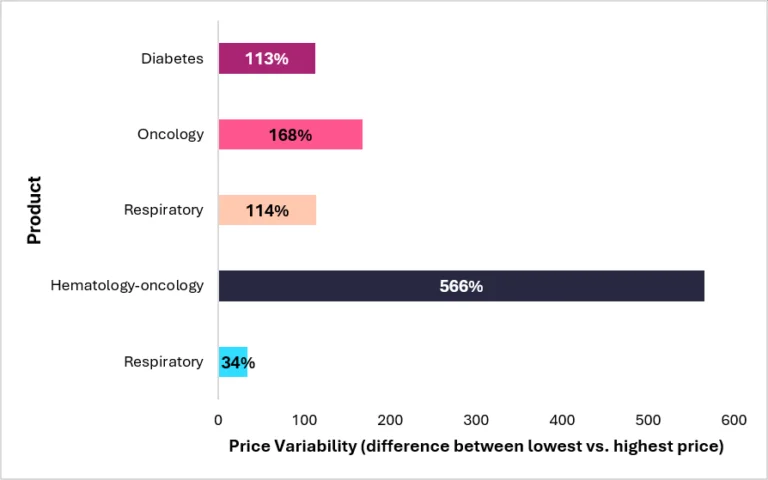
Note. All prices for each product were assessed on a consistent unit basis and are listed in US dollars.
Conclusion
This analysis demonstrates that comparator selection varies meaningfully across international HTA bodies, even when evaluating the same product and indication. This variability is often driven by heterogeneity in clinical practice patterns, as well as HTA methodological approaches.
Variability in comparator selection plays an important role in subsequent differences in HTA recommendation and the price negotiations or reimbursement decisions they inform. Consequently, prices established in international markets may reflect value determinations that are specific to the clinical and reimbursement environments in which they were generated and the health authority’s choices in designing their value assessment approach.
As US policymakers continue to consider proposals that incorporate international reference pricing, understanding the factors that shape ex-US pricing and reimbursement decisions becomes increasingly important. International benchmark prices are often informed by HTA processes that incorporate local treatment paradigms and value frameworks that may differ within reference countries and may not reflect US clinical practice or healthcare priorities.
These findings suggest that comparator selection is one important consideration when interpreting international prices and assessing their applicability within the US healthcare context. Understanding these underlying differences and what informs them is critical when interpreting international prices in a US policy context.
Funding for this research was provided by Pharmaceutical Research and Manufacturers of America (PhRMA). Avalere Health retained full editorial control.
To learn more about the impact of Most Favored Nation policies on US and international drug pricing and patient access, connect with us.