
thought leadership
Differences in Part B and D pricing for IPAY 2028 drugs
By Annie Song, Tim Collins, Kate Davidson, Brooke Fruman, Arka Ghosh | October 30, 2026
As the Medicare Drug Price Negotiation Program expands to include Part B drugs, stakeholders should understand how Part B billing and utilization may influence key negotiation price benchmarks.
Written by:


Research Scientist II


Associate Principal

Background
For the first time since the program began, the list of drugs selected for the Inflation Reduction Act’s Medicare Drug Price Negotiation Program included Part B drugs. IPAY 2028 was the first year in which the Centers for Medicare and Medicaid Services (CMS) considered Part B drugs for its selection list, announced in January of this year. Of the 15 drugs selected for IPAY 2028, four are primarily Part B drugs: Botox, Cimzia, Entyvio, and Orencia; two additional drugs (Cosentyx and Xolair) have some Part B utilization. For these selected drugs, CMS will consider a range of therapeutic alternative drugs, with some including both Part B and D utilization, to use as reference points during their negotiations
Including therapies with mixed Part B and D into negotiations introduces new challenges, as pricing can differ between the two benefits, adding uncertainty to the process. These differences stem from how CMS calculates 30-day equivalent supply (30DES) and 30DES net price in Part D vs. Part B. In Part D, CMS uses the days supply in the PDE record. In contrast, for Part B, inclusive of Medicare Advantage, CMS uses the days between administrations to calculate the 30DES net price. In simple terms, Part D uses the intended prescribing, while Part B uses the actual administration of the therapies. Other factors can contribute to differences, including indications, dosing schedules, dose amounts and access between FFS and Medicare Advantage. 30DES pricing differences occur because the weighted average affects the ceiling price and the starting point when therapeutic alternatives include mixed Part D and Part B drugs. A shift in utilization in either Part B or D can accordingly shift the relevant net 30DES net price up or down. To understand the extent of net pricing differences, Avalere Health replicated CMS’s approach to calculating the volume-weighted 30DES and 30DES net price for IPAY 2028 selected drugs and their therapeutic alternatives that include meaningful Part D and B utilization.
Results
Figure 1. Estimated net prices per 30DES for selected immunology drugs and potential therapeutic alternatives, Part B and Part D
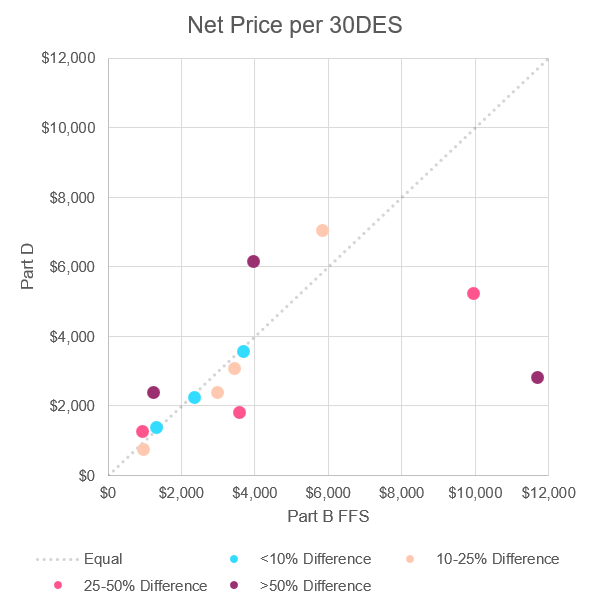
Figure 2. Estimated net prices per 30DES under $4,000 for selected immunology drugs and potential therapeutic alternatives, Part B and Part D
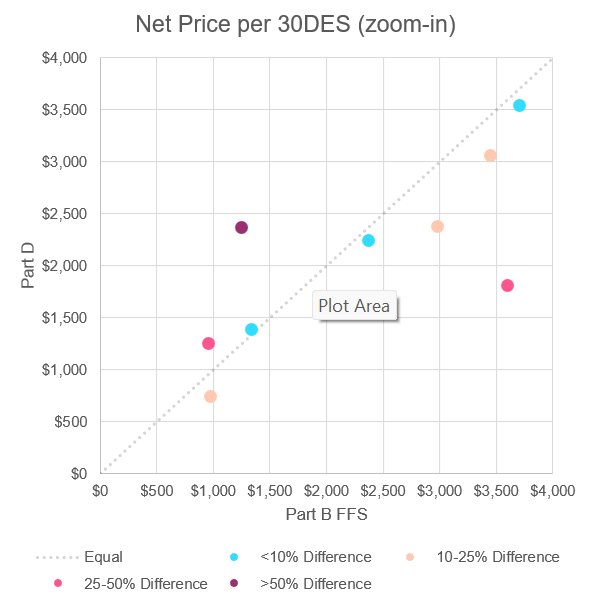
In general, most net prices per 30DES are substantially different, with only three of the thirteen therapies having Part B and Part D 30DES net prices within 10% of each other drugs with 30DES net prices below $4,000, Avalere Health found that most Part D net prices were within 25% of the FFS Part B price, with three drugs differing by more than 25% between Part D and
Utilization differences between FFS Part B coverage and MA physician-administered drug coverage can further complicate differences in 30DES net price. Although CMS will apply ASPs consistently to utilization from FFS and MA, the number of ASP billing units per 30DES can vary between FFS and MA, leading to different Part B net prices per 30DES. Across the four selected therapies with Part B volume, Avalere Health found that MA had fewer ASP billing units per 30DES than FFS (Figure 2).
Figure 3. ASP billing units per 30DES across the four selected drugs
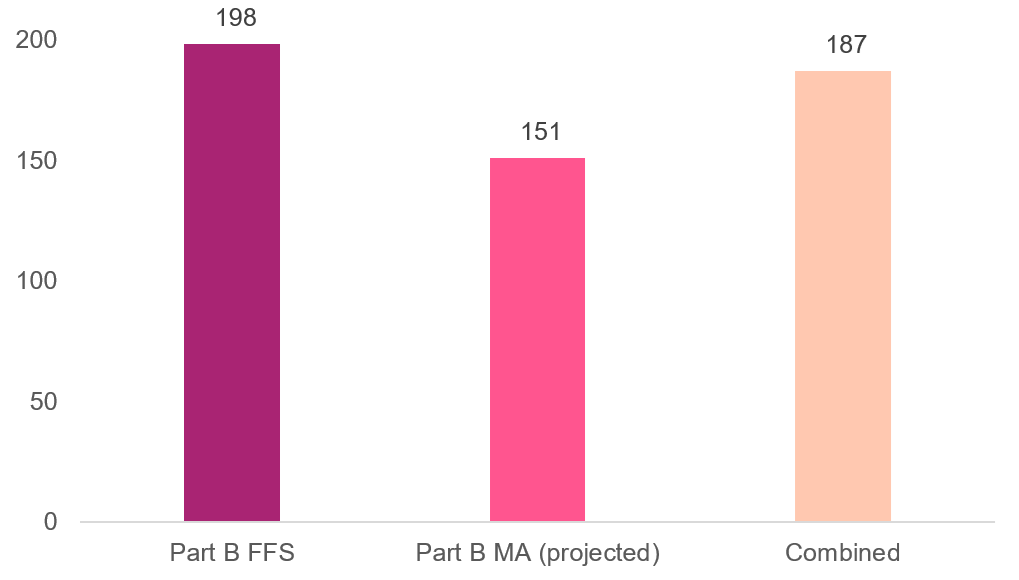
Figure 2 highlights a second important point: 30DES net prices differ not only between Part B and D, but also between Part B FFS and MA. The above evidence highlights an important aspect of negotiation. When mixed utilization exists, manufacturers need to fully understand the 30DES and associated net prices for Part D, Part B FFS, and MA, as their accurate representation is critical for a successful negotiation.
Avalere Health identified four IPAY 2028 immunology drugs with Part B volume during the time period of analysis. Avalere Health then relied on clinical expertise to identify with volume from both Part B and Part D.
We calculated and estimated utilization measures and costs according to , within the limitations of data availability. Net pricing was based on estimates of net pricing sourced from SSR Health LLC and CMS-published payment limits.
Avalere Health used Medicare data through an agreement with CMS, wherein Avalere Health has access to data from CMS’ Chronic Conditions Warehouse Virtual Research Data Center, including:
- 100% Medicare fee-for-service Part B claims
- 100% Part D prescription drug event data
- 100% Medicare Advantage (MA) encounter data
Based on MA encounter data availability, Avalere Health projected forward the latest available MA data to the same period as that for FFS Part B claims.
Disclaimer
Avalere Health conducted an analysis of Medicare data sourced from the Centers for Medicare & Medicaid Services’ Virtual Research Data Center (“VRDC Data”). Avalere relies upon the accuracy and completeness of these VRDC Data without inquiry and makes no assurances or warranties in relation to the accuracy or completeness of the VRDC Data. CMS retains ownership of the use of the VRDC Data and the use of such data is subject to the terms of the contract and CMS rules.
Net pricing and gross-to-net analytics sourced from SSR Health LLC. SSR Health’s estimates are independently derived and do not reflect publicly disclosed net prices.
Michael Ciarametaro also contributed to this article.