
thought leadership
OBBBA and Medicare negotiation eligibility: Considerations for manufacturers
By Brooke Fruman, Arka Ghosh, Annie Song | November 6, 2026
For IPAY 2028 and beyond, the OBBBA expands the exclusion for orphan drugs subject to Medicare negotiation, with implications for negotiation selection timing and targeted drug spending.



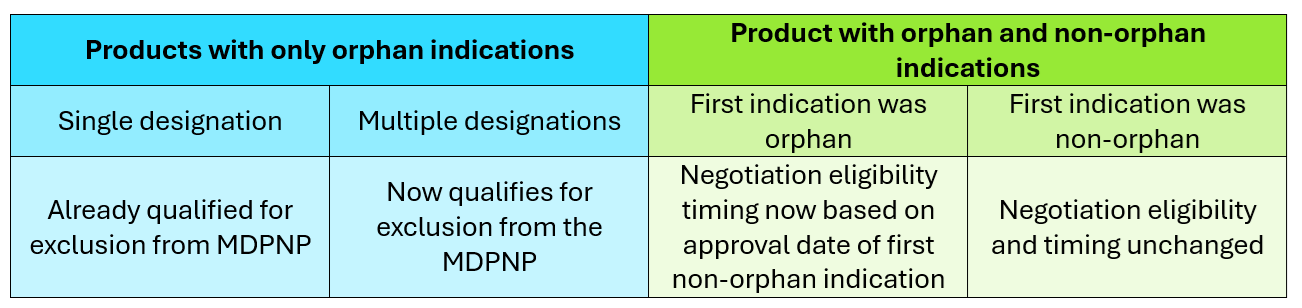
When the Medicare Drug Price Negotiation Program (MDPNP) was established in 2022, it excludes products with indication(s) approved under a single orphan drug designation. The One Big Beautiful Bill Act (OBBBA), which passed in July 2025, expanded the orphan exclusion requirements. These changes will go into effect in initial price applicability year (IPAY) 2028 (Table 1).
Table 1. OBBBA provisions on orphan drug exclusion (ODE) requirements
In June 2026, Democrats in the Senate Finance Committee issued an RFI on policy options to lower drug prices. Specifically, they requested proposals to allow the HHS Secretary “to negotiate more drugs each year” and “negotiate prices earlier in drug product lifecycles and when such negotiations should occur on small molecule and biologic drugs.”
To inform current policy conversations on potential changes to the MDPNP, Avalere Health sought to understand how the OBBBA’s changes to orphan exclusion requirements affect the timing of selection and targeted drug spending in IPAYs 2028 – 2033. The analysis uses Avalere Health’s proprietary MDPNP forecast model to determine the potential impacts.
Impacts of the policy change
As a result of this policy modification, the estimated negotiation selection timeline and associated drug spending will change for IPAY 2028 and future years. Due to these shifts, Avalere Health estimates that:
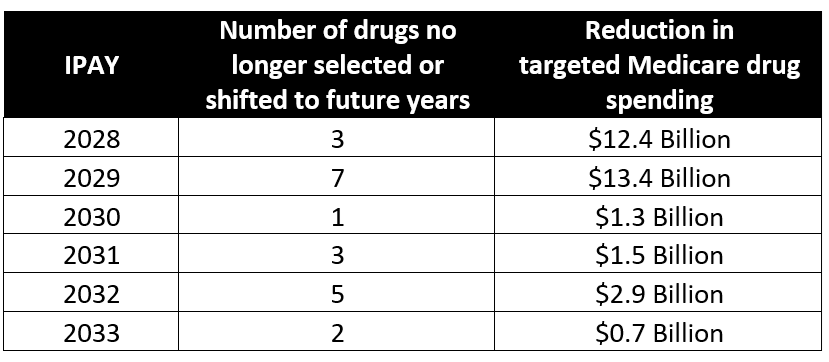
- Three products— two Part B drugs and one Part D drug— that were slated for negotiation in IPAY 2028 will have shifted to selection in later years (Figure 2).
- For IPAY 2029, seven products will no longer be selected or will shift to selection in later years. The number of drugs affected in other IPAYs ranges from only one in IPAY 2030 to five in IPAY 2032, reflecting the new OBBBA provisions.
- A total of 43 additional products with only orphan indications will now be excluded from the MDPNP
- Across IPAYs 2028–2033, there is a meaningful reduction in targeted Medicare drug spending due to the exclusion or delayed selection of drugs. The difference in total projected Medicare spend on the selected drugs before and after OBBBA implementation is estimated at over $32 billion, with the largest reductions occurring in IPAYs 2028 and 2029 of over $12 and $13 billion, respectively (Table 2).
Table 2. Impact of OBBBA orphan drug exclusion requirements
Implications
The OBBBA introduced new complexity to MDPNP eligibility. Identifying products eligible under the new ODE, including their dates of first non-orphan indication approval, is challenging because there are no centralized, comprehensive data sets. This makes it more challenging for stakeholders to forecast expected selection timing. However, understanding potential negotiation timing has critical implications for evidence generation and commercial strategy planning.
For products with an extended window for negotiation preparation, there are increased opportunities to generate evidence before selection. On the other hand, as some manufacturers may experience extended MDPNP ineligibility, others will take their place in earlier years of list selection. For these manufacturers, now is the time to catalyze internal teams to prepare for and understand the impacts of negotiation.
Even if the OBBBA provisions do not directly affect a product’s negotiation eligibility risk, they may affect a manufacturer’s competitors, which can have ripple effects on market strategies to address changing price pressures and payer management, among other dynamics.
More broadly, stakeholders (e.g., investors, manufacturers) may consider the OBBBA impacts on long-term R&D strategies, such as indication sequencing decisions.
Next steps
It is imperative that life science organizations understand these policy changes in terms of impact to projected MDPNP drug selection and subsequent R&D, HEOR, and market access strategies.
Avalere Health has developed a comprehensive, validated, and flexible tool that lets users adjust various IRA eligibility criteria, including the OBBBA provisions and drug-specific market events, and assess the impact on drug selection timing forecasts. Additionally, Avalere Health’s experts have extensive experience supporting negotiation preparation and understanding downstream MDPNP market strategies. Connect with us to learn more.
Methodology
Avalere Health used Medicare data through an agreement with the Centers for Medicare and Medicaid Services (CMS), wherein Avalere Health has access to data from CMS’ Chronic Conditions Warehouse Virtual Research Data Center, including:
- 100% Medicare fee-for-service Part B claims
- 100% Part D prescription drug event data
- 100% Medicare Advantage (MA) encounter data
Avalere Health also used additional data sources for its proprietary MDPNP forecast model, including publicly available information from the Food and Drug Administration to identify details relevant to a drug’s eligibility for Medicare price negotiation under the IRA.
Disclaimer
The analysis relies on Medicare data sourced from the Centers for Medicare & Medicaid Services’ Virtual Research Data Center (VRDC Data). Avalere relies upon the accuracy, and completeness of the VRDC Data without inquiry and makes no assurances or warranties in relation to the accuracy or completeness of the VRDC Data. CMS retains ownership of the use of VRDC Data, and the use of such data is subject to the terms of Avalere’s agreement with CMS and CMS rules.
Miron Dilmanian, Michael Ciarametaro, and Milena Sullivan also contributed to this article.
NOTE: This is an update to a previously published article.